The Scam That Makes You Pay to Prove You're Innocent: How a Video Call Became a ₹49.78 Lakh Trap
By AsliReview Team · 9 October 2026
You answer a WhatsApp video call from an unknown number. A disturbing image flashes on screen. You disconnect immediately and block the number. Problem solved — or so it seems.
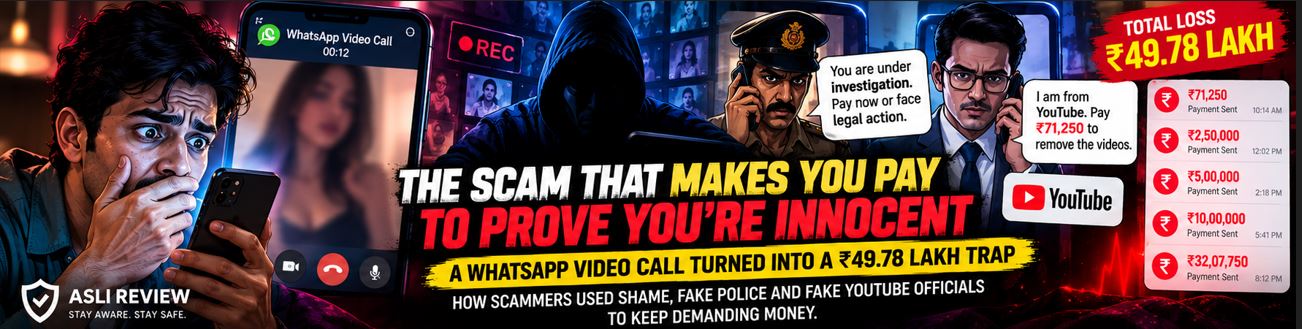
According to a cybercrime complaint reported out of Ahmedabad, a 25-year-old private-sector employee did exactly that after a call on September 3, 2026. The scammers followed up claiming they'd recorded a compromising video and threatened to circulate it. He blocked them again. Weeks later, on September 27, they came back with a different weapon entirely: a caller claiming to be an officer from the Delhi Cyber Crime Branch, who threatened police action over the alleged video. A second caller, claiming to be a YouTube executive, said two "objectionable videos" had appeared in the victim's name and demanded ₹71,250 to have them removed.
He paid. The demands didn't stop. By the time he realized he was being scammed — only after the fraudsters kept asking for more even after repeated payments — he had reportedly transferred a total of ₹49.78 lakh.
AsliReview Editorial Note: This case is based on police information and widely reported in the Indian press (India Today, NewsBytes, The CSR Journal, and others). The core sequence — initial sextortion attempt, fake Cyber Crime Branch officer, fake YouTube official, escalating payments totalling ₹49.78 lakh — is well corroborated. The investigation into the accused was reportedly ongoing at the time of reporting.
1. Shock, first. An unexpected, disturbing video call creates an emotional reaction before the victim has time to think it through.
2. Shame, next. A threat to share the video turns a strange phone call into a personal crisis — reputation, family, career all feel at risk.
3. Authority, then. A second caller poses as a police/cyber-crime officer, which reframes "an online threat" as "a real legal case."
4. A "solution," conveniently supplied. A third caller, posing as a platform official (here, YouTube), offers to make the problem go away — for a fee.
5. The first payment locks the victim in. Having paid once, it becomes psychologically harder to walk away — each new demand is framed as the "final" step needed to resolve things.
6. The story keeps changing; the ask doesn't. Verification fees, legal clearance, processing charges — different pretexts, same goal: another transfer.
Why It Works
Fear overrides careful thinking. The combination of shame and legal threat is designed to make victims act before they verify anything.
Multiple fake identities reinforce each other. A lone blackmailer is easy to dismiss; a "police officer" backing up the threat, followed by a "platform official" offering a fix, makes the whole sequence feel like one connected, legitimate process.
The first payment creates a sunk-cost trap. Once money has been sent, stopping feels like giving up on recovering it — so victims keep paying rather than cut losses.
Isolation is deliberate. Victims are discouraged from telling anyone, which removes the single easiest way to break the spell: an outside, calmer perspective.
Warning Signs
An unsolicited video call containing shocking or compromising content
A follow-up threat to "circulate" or "leak" a video or image
A second caller claiming to be police, cyber crime branch, or any law-enforcement authority over a video call or WhatsApp
A third party claiming to represent a tech platform (YouTube, Instagram, etc.) and offering to "resolve" the issue for payment
Any demand that the matter be settled immediately, with no time to verify
The person who created the emergency is also the one offering the solution
Reality Check
Myth: "A video call or ID card is proof of who someone says they are." Reality: a badge, uniform, or call background is trivial to fake — none of it is independent verification.
Myth: "The police can threaten arrest or demand payment over a phone/video call." Reality: no genuine Indian law-enforcement process works this way — real legal action goes through an FIR and a police station, never a direct payment demand on a call.
Myth: "If I just pay this once, it will be over." Reality: in this case, and in most reported sextortion/impersonation scams, the first payment is typically the beginning of more demands, not the end.
What To Do
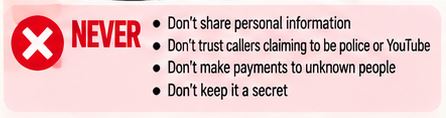
1. Don't pay, and don't negotiate. There's no guarantee the demand stops after one payment — in the most common pattern, it doesn't.
2. Disconnect and don't re-engage emotionally. Block the number if needed; give yourself space away from the pressure before deciding anything.
3. Verify independently. If someone claims to be police, a government department, or a company representative, find that organization's official contact information yourself — never use a number the caller gives you.
4. Tell someone you trust. These scams rely on isolation and shame; breaking that silence is often what stops the escalation.
5. If money has already been sent, contact your bank immediately and report via 1930 or cybercrime.gov.in — sextortion is a recognized category on the National Cyber Crime Reporting Portal.
6. Preserve evidence (screenshots, numbers, chat logs, transaction IDs) rather than deleting it out of embarrassment.
Can someone really blackmail me over a WhatsApp video call?
Yes — online sextortion, where someone threatens to share private or sensitive content to extort money, is a recognized and reported form of cybercrime in India.
What if a caller claims to be a police officer investigating me?
Verify independently through the police department's official contact details — never through a number, ID, or document the caller provides. No genuine agency demands payment over a call to resolve a case.
Should I pay to have an alleged video removed?
No. Paying doesn't guarantee the demands stop — in most reported cases, it leads to further demands rather than resolution.
AsliReview Tip: No genuine authority needs your panic to prove its authority. If someone wants you scared, ashamed, and transferring money immediately, that urgency itself is the warning sign — stop, verify independently through channels you find yourself, then decide.