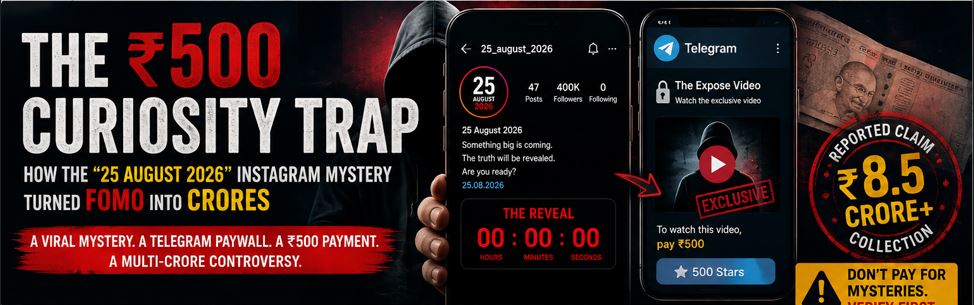
The ₹500 Curiosity Trap: How the “25 August 2026” Instagram Mystery Turned FOMO Into Crores
By AsliReview Team · 4 September 2026
It started with something incredibly simple: a date. 25 August 2026.
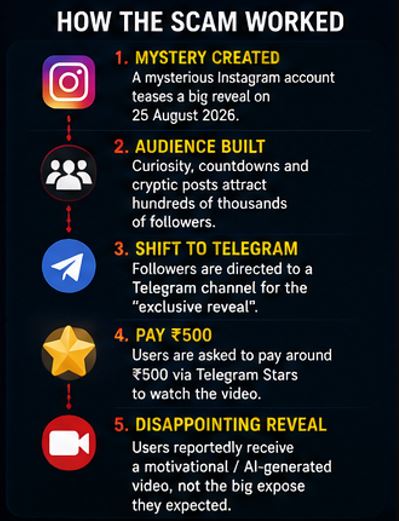
An Instagram account was created around that date and began building mystery around what would supposedly happen on August 25. Instead of immediately explaining the announcement, the account reportedly teased its followers with cryptic posts and videos suggesting that something significant would be revealed.
The audience was left with one obvious question: "What is going to happen on 25 August?" And that question became the product.
The mystery itself attracted attention. According to media reports, the account eventually attracted roughly 4 lakh followers. People followed the account, shared the content, speculated, and waited. And the closer August 25 came, the more valuable the mystery became.
The Secret Was Never the Product
This is perhaps the most interesting part of the entire story. The campaign did not need to tell people what they were going to receive. It only needed to convince them that "whatever it is, I need to know." That is a powerful psychological trigger.
Instead of selling a product, the campaign was effectively selling curiosity. Instead of saying "buy this ₹500 video," the message was closer to "something huge is going to happen, wait for it." The audience created the excitement themselves.
Then Came the Big Day
On 25 August 2026, the campaign reportedly directed followers toward a Telegram channel. According to reports, followers were told that the expected content would be available there, with some messaging suggesting that the content could be deleted from Instagram.
The mystery had now moved platforms: Instagram → Telegram → exclusive content → ₹500 payment. Reports say users were asked to pay approximately ₹500 through Telegram Stars to access the content.
Why ₹500?
Think about the number. ₹50 might feel trivial. ₹5,000 might make many people stop and investigate. But ₹500 sits in an interesting psychological zone. For many people, it is "it's only ₹500, let's see what the big reveal is." That is precisely why low-value payments can become incredibly powerful when applied at scale.
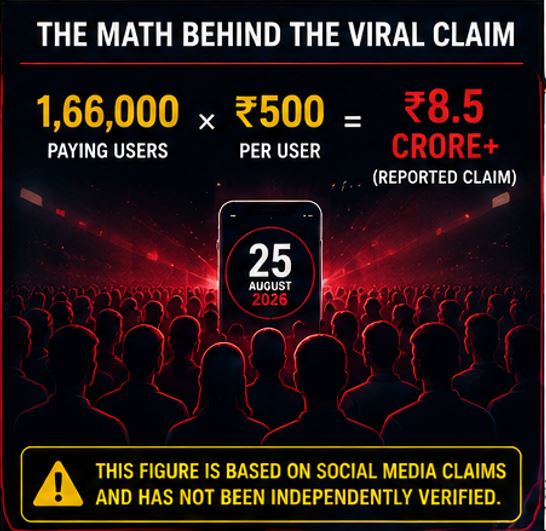
Consider the mathematics: 10,000 people × ₹500 = ₹50 lakh. 50,000 people × ₹500 = ₹2.5 crore. 100,000 people × ₹500 = ₹5 crore. 166,000 people × ₹500 = ₹8.3 crore. The amount doesn't need to be huge per person — the audience does the multiplication.
The Reveal
And then came the moment everyone had supposedly been waiting for. The promised content was reportedly released, but many paying users were disappointed. According to reports, instead of the major exposé or revelation that many followers expected, they received a motivational/AI-generated video with ordinary messaging around time, productivity and similar themes.
The internet reacted almost immediately. People who had paid began questioning what they had actually purchased. And the story exploded.
How Much Money Was Actually Collected?
This is where AsliReview needs to be extremely careful.
A viral claim circulated that approximately 1.66 lakh people paid ₹500 each, producing an estimated collection of around ₹8.5 crore. That figure was reported by multiple outlets, but it has not been independently verified — one outlet explicitly noted that the payment count and total amount were based on social-media claims. Other reports have circulated different figures, including claims based on approximately one lakh payments.
Therefore: ₹8.5 crore should be treated as a reported social-media claim — not a confirmed amount. The calculation itself is straightforward (1.66 lakh × ₹500 ≈ ₹8.3 crore), but the number of actual paying users is what remains unverified. A viral number is not automatically a verified financial record.
Was This Actually a Scam?
This is where things get complicated. Many people online called it a scam. Others called it brilliant marketing. And that debate is important.
Why people called it a scam: the criticism largely comes from the argument that the campaign created an expectation of a major revelation, collected payment for access, and then delivered content that did not match what many users believed they were paying for.
Why others called it marketing: the campaign never explicitly promised a specific celebrity, political or criminal exposé. It created mystery. People became curious. People voluntarily paid ₹500. They received content. From this perspective, some argued it was simply an extremely aggressive form of curiosity-driven marketing.
The Honest AsliReview Position
Based on publicly available reporting, we should not declare a final legal conclusion that the campaign was fraud. What we can say is: the campaign generated widespread allegations of deceptive marketing and scam-like behaviour after users paid for a highly anticipated reveal and reportedly received content that many considered substantially different from what the campaign had led them to expect. The reported financial figure is also not independently verified.
But there is a bigger lesson here. Whether you call it a scam, deceptive marketing, FOMO marketing, a publicity stunt, or brilliant internet marketing — there is something every consumer should understand: your curiosity can be monetised. And social media has made this incredibly easy.
The New Fraud Trend: Curiosity Fraud
At AsliReview, we call this pattern Curiosity Fraud. The victim isn't necessarily promised money. They aren't necessarily threatened. They aren't necessarily offered a huge discount. Instead, they're given a question: "Do you want to know something that everyone else doesn't know?"
The uncertainty creates curiosity. Curiosity creates attention. Attention creates followers. Followers create social proof. Social proof creates FOMO. FOMO creates payment.
The Curiosity-to-Payment Funnel
The pattern looks like this: mystery → curiosity → countdown → social sharing → follower growth → FOMO → exclusive platform → paywall → ₹500 payment → reveal.
This is a powerful psychological funnel, and it doesn't require sophisticated hacking. No malware. No stolen OTP. No fake bank website. No account takeover. Just human psychology.
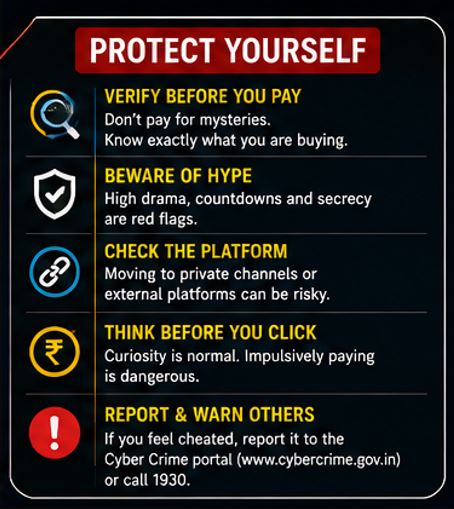
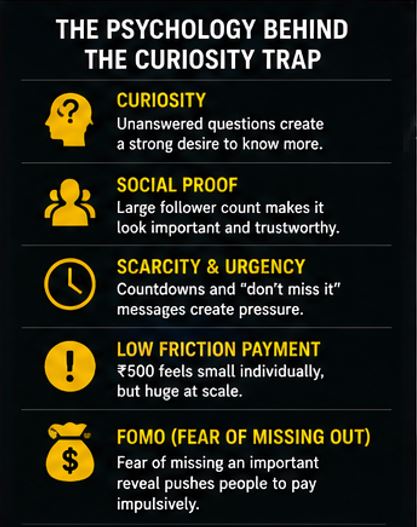
Trigger #1: Curiosity
Humans naturally want answers to unanswered questions. If someone tells you "I know something you don't," your brain wants to know what it is. That's why mystery works so well — the less information provided, the more room people have to imagine what the answer might be.
Trigger #2: FOMO
FOMO means Fear Of Missing Out. Once thousands of people start discussing something, a new thought appears: "What if everyone else sees it and I don't?" That thought can be surprisingly powerful, and social media makes it worse because you constantly see comments, reels, shares, stories, reaction videos, speculation, screenshots, and memes. The event starts feeling bigger than it actually is.
Trigger #3: Social Proof
Suppose you see 400,000 followers. You may subconsciously think "surely this many people can't be wrong." But follower count does not prove legitimacy, accuracy, quality, honesty, value, or safety. A viral account is still an account — popularity is not verification.
Trigger #4: Scarcity
The next trick is often "today only," "don't miss it," or "this will be deleted." Suddenly, you don't have time to think. And that's exactly when you should think.
Trigger #5: Platform Migration
The move from Instagram to Telegram is particularly interesting. There is nothing inherently suspicious about using Telegram — creators, businesses and communities legitimately use multiple platforms. But when the sequence becomes public Instagram account → mystery → private Telegram channel → exclusive content → immediate payment, you should slow down.
The move creates a sense of exclusivity — "the real information is somewhere else" — that can make people feel they have reached an inner circle.
Trigger #6: Low-Risk Thinking
₹500 doesn't feel like a major financial decision to many people. That's the danger. The brain says "if it's fake, I've only lost ₹500." But at scale, ₹500 × thousands of people = crores. A small individual decision can become an enormous revenue stream for the person on the other side.
The Most Dangerous Sentence
There is one sentence you should be careful about: "It's only ₹500." That sentence has justified countless impulsive online payments. Replace it with: "What exactly am I buying for ₹500?" That one question changes everything.
Before Paying, Ask These 7 Questions
- What exactly am I receiving? If the answer is vague, stop.
- Who am I paying? Can you identify the individual or organisation?
- Where is the payment going? Is the payment method transparent?
- What was actually promised? Don't rely on your imagination — look at the exact wording.
- Is there a refund policy? If there is no clear refund or grievance mechanism, consider the risk.
- Can I verify the claim independently? Search outside the account's own posts.
- Would I still pay if there were no countdown? If the answer is no, FOMO may be influencing you.
A Crucial Distinction: What You Expected vs What Was Promised
This is one of the biggest lessons from the incident. There is a difference between what the seller actually promised and what the audience imagined the seller promised.
If a creator says "something will happen on August 25," people may imagine a celebrity exposé, political news, a leaked video, a major announcement, a scandal, or a secret revelation. But those assumptions may come from the audience — not necessarily from an explicit promise.
Therefore, before paying: read the actual claim. Don't pay for the story your imagination created.
💡 AsliReview Tip
Never pay to solve a mystery you haven't verified. If someone wants ₹500 before telling you what you're buying, pause. Ask: what exactly is being sold? If the answer is still "you'll find out after you pay," then you're not buying information — you're buying uncertainty.
📌 Reality Check
Myth: If an account has hundreds of thousands of followers, it must be genuine.
Reality: Popularity is not proof of legitimacy.
📌 Reality Check
Myth: ₹500 is too little to be a scam.
Reality: A small payment multiplied across a large audience can become a substantial amount.
📌 Reality Check
Myth: If I receive a video after paying, it cannot be misleading.
Reality: Receiving something does not automatically mean that the product matched the representation that influenced your purchase.
📌 Reality Check
Myth: Telegram means the offer is suspicious.
Reality: Telegram is a legitimate communication platform. The risk comes from the particular account, offer, payment request and behaviour — not simply the platform.
📌 Reality Check
Myth: Everyone is talking about it, so it must be important.
Reality: Viral attention can be generated by curiosity, controversy and FOMO.
📌 Reality Check
Myth: The ₹8.5 crore figure is confirmed.
Reality: The figure has been widely reported as a social-media claim but has not been independently verified.
The AsliReview 5-Second FOMO Test
Before paying for a viral online offer, ask yourself:
- STOP — why am I about to pay?
- REMOVE — remove the countdown and hype. Would I still buy it?
- READ — what exactly was promised?
- VERIFY — can I verify who is selling it?
- DECIDE — would I willingly pay for the actual product, not the mystery around it?
If you cannot answer these questions, don't pay yet.
The AsliReview Curiosity Rule
Curiosity is free. You don't have to pay immediately just because someone has successfully made you curious. The internet is full of rumours, teasers, fake reveals, staged controversies, misleading headlines, AI-generated content, fabricated screenshots, fake leaks, and countdown campaigns.
Your curiosity is valuable. Don't let someone else decide its price.
What Creators Can Learn From This
There is another side to this story. The campaign demonstrates the enormous power of mystery, storytelling, suspense, timing, social media, low-friction pricing, and community psychology. From a marketing perspective, it shows how powerful curiosity can be.
But there is an important boundary: marketing should not depend on deliberately creating a materially false expectation about what the customer is buying. Consumers should be able to understand the product before paying for it.
What Platforms Should Learn
Social-media platforms are increasingly becoming commercial marketplaces. People don't just watch content anymore — they buy products, subscribe, join channels, pay creators, invest, donate, participate in communities, and click external links.
That means platforms need strong systems for identifying deceptive commercial behaviour, especially when viral accounts move users toward external payment channels.
What Consumers Should Learn
The biggest lesson is not "never trust Instagram." It is: don't confuse attention with credibility.
An account can have 100 followers or 400,000 followers and still require verification. A countdown is not evidence. A viral reel is not evidence. A Telegram channel is not evidence. A ₹500 price is not evidence. And thousands of people paying does not prove that the underlying claim is true.
The Bigger Fraud Trend
Traditional scams often exploit greed ("earn ₹50,000 today"), fear ("your bank account will be blocked"), or urgency ("pay immediately"). But the next generation of online manipulation increasingly exploits curiosity — "you won't believe what happens next," "everyone will know tomorrow," "the biggest secret will be revealed," "only members will see it," "pay before the content disappears."
The emotional trigger changes. The objective remains the same: get you to act before you think.
AsliReview's Bottom Line
The "25 August 2026" controversy is a fascinating example of how modern online campaigns can turn mystery into attention, attention into FOMO, and FOMO into payments.
Reports say that a mysterious Instagram account built a large audience around the promised August 25 reveal, eventually directing followers to Telegram, where access reportedly cost around ₹500. The final content reportedly disappointed many paying users, and claims of approximately ₹8.5 crore in collections subsequently went viral.
But the ₹8.5 crore figure has not been independently verified, and whether the campaign legally qualifies as fraud cannot be determined from social-media reactions alone.
There is, however, a lesson that doesn't require a courtroom or an investigation: don't pay for a mystery. Before sending ₹500 — or ₹5,000 or ₹50,000 — ask what you are actually buying.
Because the internet has discovered something very powerful: people don't always pay because they want something. Sometimes they pay because they desperately want to know. And that curiosity can be worth crores when enough people are watching.
Remember: FOMO makes you hurry. Curiosity makes you click. Hype makes you trust. Pause makes you verify.
When someone sells you a mystery, keep your ₹500 until you know the answer.

Report it on AsliReview and help protect others from the same fraud.
🚨 Report a Fraud →