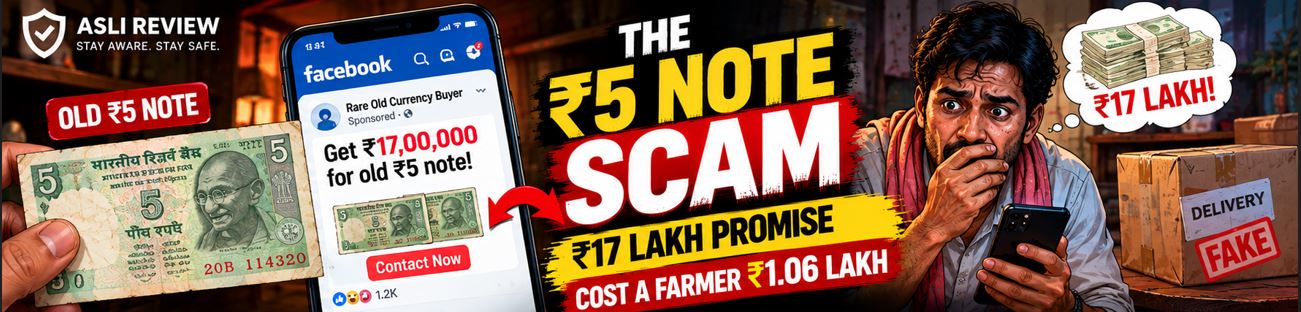
The ₹5 Note Scam: How a ₹17 Lakh Promise Cost a Farmer ₹1.06 Lakh
By AsliReview Team · 12 October 2026
An old currency note. A Facebook advertisement. A promised fortune. And a parcel that never arrived.
What would you do if someone offered you ₹17 lakh for an old ₹5 note?
You might laugh.
You might get curious.
Or you might wonder whether the note lying inside your cupboard is actually worth a fortune.
That curiosity is exactly what fraudsters can exploit.
In a reported case from Gujarat, a farmer allegedly lost ₹1,06,400 after responding to a Facebook advertisement promising ₹17 lakh for an old ₹5 note.
The fraud reportedly unfolded over three days. The victim was promised a huge payout, but every step towards receiving it brought another demand for money.
The promised fortune never arrived.
The payment requests kept coming.
Fraud Snapshot
*The details above are based on media reporting of the complaint. The allegations have not been treated as established findings of guilt.*
---
What Happened?
According to an India Today report published on October 10, 2026, a 42-year-old farmer from Gujarat came across a Facebook advertisement offering ₹17 lakh for an old ₹5 note.
He reportedly had two such notes.
The offer suggested that the notes could bring him ₹34 lakh.
He contacted the number advertised and shared photographs of the notes through WhatsApp.
Soon, someone contacted him with an explanation: a person would come to collect the notes and deliver a parcel containing the promised money.
There was just one small condition.
He had to pay a fee to receive the parcel.
The amount was ₹750.
Compared with the promised ₹34 lakh, it probably seemed insignificant.
And that was the first trap.
---
The First Payment Was Only the Beginning
The farmer reportedly paid ₹750 after receiving a QR code.
But the promised parcel did not arrive.
Instead, on October 7, he allegedly received another call.
This time, the caller claimed that the person carrying the parcel had been caught.
To secure the person's release, the farmer was asked to pay another ₹25,500.
He reportedly paid.
The following day, another caller allegedly claimed that more money was needed because their associates had been caught.
This time, the demand was ₹53,000.
The farmer continued making payments, hoping to receive the promised fortune.
Over the three days, he reportedly transferred ₹1,06,400.
Eventually, he realised that he had been cheated and approached the police.
The investigation began.
The promised money remained undelivered.
The only money that actually moved was the victim's.

---
The ₹5 Note Wasn't the Real Trap
At first glance, this looks like a simple case of someone falling for an unrealistic offer.
But look at the sequence.
The scammers allegedly did not ask for ₹1 lakh immediately.
They started with ₹750.
Then came ₹25,500.
Then ₹53,000.
Each demand was connected to a new explanation for why the promised money could not be delivered.
This approach can exploit several psychological weaknesses.
Curiosity
Could an old note really be worth a fortune?
Hope
What if the opportunity is genuine?
Commitment
I've already paid. I should not give up now.
Fear of losing the opportunity
If I don't pay this fee, I might lose the promised payout.
Sunk-cost thinking
I've already spent money. One more payment might finally solve everything.
These reactions are human.
They do not mean someone is foolish.
The scammer's advantage comes from constructing a situation in which the next payment appears to be the easiest way out.
---
The AsliReview Payment Escalation Trap
Here's the pattern worth remembering.
Stage 1: The Dream
> "You can earn ₹17 lakh from this old note."
Stage 2: The Entry Fee
> "Pay a small amount to arrange delivery."
Stage 3: The Emergency
> "The parcel is stuck. Something has happened to the person carrying it."
Stage 4: The Clearance Fee
> "Pay more to resolve the problem."
Stage 5: The Final Demand
> "One last payment, and everything will be completed."
Stage 6: The Endless Loop
Another problem appears.
Another payment is requested.
The numbers may change.
The excuses may change.
But the central mechanism remains the same:
> The victim must keep paying to unlock money that has never been independently verified.
---
Can an Old ₹5 Note Really Be Worth Lakhs?
This is an important question.
Some old banknotes and coins can interest collectors. Their value, where one exists, depends on factors such as:
* Rarity * Condition * Historical significance * Demand * Authenticity * Collector interest
But an old note is not automatically valuable simply because it is old.
And an advertisement claiming that a note is worth lakhs is not proof of its market value.
Before considering a sale, ask:
* Is there credible evidence of demand for this exact note? * Can the buyer's identity and reputation be independently verified? * Is there a documented, verifiable valuation? * Is the proposed price supported by actual comparable sales? * Is the buyer asking you to pay unexplained fees before purchasing it?
A seller should be particularly cautious when an unknown buyer promises an extraordinary amount and immediately introduces payment conditions.
---
The RBI Warning
The Reserve Bank of India has previously warned the public about fraudulent offers involving the purchase and sale of old banknotes and coins.
The RBI has clarified that it does not conduct such transactions and does not authorise people or firms to collect charges or commissions on its behalf for them.
Fraudsters may misuse the RBI's name or logo to make their offers appear genuine.
Do not confuse a claim made in an advertisement with an official RBI scheme.
---
The Fake Parcel Trick
Why did the scammers allegedly introduce a parcel at all?
Because a parcel makes an imaginary payment feel tangible.
The victim is no longer simply waiting for someone to transfer money.
He is waiting for something supposedly being delivered.
That creates a believable sequence in the victim's mind:
* The buyer has agreed to pay. * The money has supposedly been arranged. * Someone is carrying it. * The parcel has encountered a problem. * A fee will supposedly resolve the problem.
Every new explanation keeps the promised reward alive.
But here's the critical question:
> Where is the independently verifiable proof that the money exists and is actually being delivered?
A caller's story is not proof.
A QR code is not proof.
A photograph of a parcel is not proof.
A screenshot of a payment is not proof that money has reached your account.
---
Warning Signs
Watch for these warning signs when selling old notes, coins, collectibles or other unusual items online.
🚩 An Extraordinary Offer
Someone promises lakhs without a credible explanation of the item's value.
🚩 An Advance Payment Before the Sale
You are asked to pay registration, courier, insurance, tax or processing charges before receiving the buyer's money.
🚩 A QR Code Presented as a Way to Receive Payment
You are told to scan a code or approve a request to receive the sale proceeds.
🚩 A Parcel That Keeps Getting Delayed
Every time delivery is expected, a new problem appears.
🚩 A New Fee for Every New Problem
The demands keep increasing rather than ending.
🚩 Multiple Callers With Different Roles
One person claims to be the buyer, another a courier representative, and another an official who can release the money.
🚩 Pressure to Act Immediately
You are told that the opportunity will disappear unless you pay now.
🚩 Fake RBI Connection
Someone claims that the RBI requires you to pay a fee to complete the transaction.
The more the story depends on your next payment, the more carefully you should verify it.
---
The AsliReview Rule: Buyers Pay Sellers
For a normal sale, the buyer pays the seller for the item.
There can be legitimate transaction-related costs in some commercial arrangements, but every charge should be independently verifiable and clearly explained.
An unknown buyer promising an extraordinary payout should not be trusted simply because the first fee is small.
Remember:
> You are selling an item — not buying permission to receive your own sale proceeds.
If the transaction becomes a sequence of unexplained payments, stop and reassess it.
Do not send another payment just because you have already sent the previous one.
---
What Should You Do If Someone Offers Lakhs for an Old Note?
Use this checklist before responding.
1. Do not rush. An extraordinary offer deserves extra scrutiny.
2. Research the item. Look for credible collector information and comparable completed sales.
3. Verify the buyer. Do not rely solely on their social media profile or WhatsApp display name.
4. Ask for written terms. The price, payment method and collection arrangements should be clear.
5. Never pay unexplained advance fees. Be especially cautious of repeated charges supposedly needed to release a payout.
6. Read every UPI screen. Check whether you are receiving money or authorising a payment.
7. Never share your UPI PIN or OTP. You do not need to disclose these to receive a normal payment.
8. Do not trust screenshots alone. Check your actual bank statement or transaction history.
9. Keep evidence. Save advertisements, messages, phone numbers, QR codes and transaction records.
10. Walk away if the story keeps changing. You do not have to complete a suspicious transaction.
---
What If You Have Already Paid?
Do not make another payment in an attempt to recover the previous one.
Instead:
Contact Your Bank or Payment Provider
Report the transactions and ask what immediate protective action is available.
Call 1930
India's National Cyber Crime Helpline handles reports of financial cyber fraud.
File a Complaint Online
Use the official National Cyber Crime Reporting Portal.
Preserve Evidence
Keep:
* Transaction IDs and UTR numbers * Bank statements * Screenshots of the original advertisement * WhatsApp conversations * Phone numbers and caller details * QR codes and payment requests * Any parcel tracking details or documents supplied by the scammers
Report promptly.
Quick reporting may help authorities and financial institutions take action, although recovery is not guaranteed.
---
Reality Check: Does the RBI Buy Old Notes From the Public?
No.
The RBI has explicitly clarified that it does not deal in buying or selling old banknotes and coins.
It has also warned that it has not authorised individuals or firms to collect charges or commissions on its behalf for such transactions.
So if somebody says:
> "Pay this RBI registration fee."
> "Pay this tax to release your old-note payment."
> "Pay the commission required by the RBI."
Do not accept the claim at face value.
Verify it through official RBI channels.
A logo, certificate, official-looking document or confident caller cannot turn an invented fee into a legitimate one.
---
The AsliReview 5-Second Rule
Before paying any fee to an unknown buyer, stop and ask:
1. What Am I Paying For?
Can I independently verify the service?
2. Why Must I Pay Before Receiving the Promised Money?
Is this a legitimate, documented arrangement — or merely another demand?
3. What Happens If I Refuse?
If the answer involves threats, invented emergencies or increasingly urgent demands, walk away.
Five seconds of scepticism can save you from days of chasing a payment that may never arrive.
---
AsliReview Tip 💡

An Extraordinary Offer Deserves Extraordinary Verification
A note may have historical or collector interest.
That does not mean every old note is worth lakhs.
Do not let the possibility of a huge payout stop you from checking the buyer, the valuation and the transaction.
And never let a small initial fee make you feel committed to a suspicious deal.
> A ₹750 payment is not proof that ₹34 lakh is waiting for you.
---
The AsliReview 10-Point Old Currency Scam Checklist
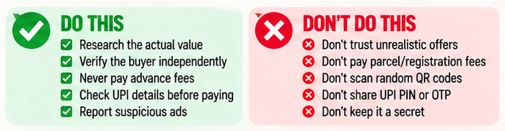
- The buyer's identity can be independently verified.
- The proposed value has credible supporting evidence.
- The sale terms are clear and documented.
- The buyer is not using a fake RBI connection.
- No unexplained advance fee is being demanded.
- No QR code is being used to trick me into authorising a payment.
- I have read the UPI transaction screen carefully.
- I have checked actual bank records rather than screenshots.
- I have not allowed urgency or a promised fortune to cloud my judgement.
- I know how to report the incident if I suspect fraud.
If the deal fails several of these checks:
# STOP.
Do not proceed until you can independently resolve the concerns.
---
FAQs
Can an Old ₹5 Note Really Be Worth ₹17 Lakh?
A particular banknote may attract collector interest, but its value depends on credible market demand and the note's characteristics.
An advertisement promising ₹17 lakh is not proof that a buyer will pay that amount.
Does the RBI Buy Old Notes and Coins?
The RBI states that it does not deal in buying or selling old banknotes and coins.
It has warned the public about fraudulent offers and unauthorised charges associated with such transactions.
Why Do Scammers Ask for Small Fees First?
A small initial payment can make the transaction appear believable and lower the victim's suspicion.
Further demands may then be presented as necessary to complete the deal.
What Is a Parcel Release Fee Scam?
It is a fraud pattern in which someone claims that a parcel containing money or a valuable item is delayed, blocked or held up.
The victim is asked to pay fees to resolve invented problems, but the promised parcel may never arrive.
Should I Scan a QR Code to Receive Money From a Buyer?
Do not scan or approve a payment request without understanding what it does.
Read the transaction details carefully.
A request to enter your UPI PIN generally authorises money to leave your account, not to enter it.
What If the Buyer Says the RBI Requires a Registration Fee?
Do not rely on the caller's statement.
Verify the claim directly through the RBI's official website or contact channels.
What If I Have Already Paid the Scammers?

Contact your bank or payment provider immediately, call 1930 and report the incident through the National Cyber Crime Reporting Portal.
Preserve all relevant evidence.
Can I Report a Suspicious Facebook Advertisement?
Yes.
Preserve the advertisement and its details, report it through Facebook's reporting tools, and report suspected cyber fraud through the appropriate official channels.
---
Related AsliReview Guides
* Fake Shopping Website Scams in India * Fake Customer Care Scam in India * Instagram Shopping Scam in India * The ₹2 Courier Scam * Fake Refund Scam in India * “Reply NO” Bank Alert Scam
---
Recommended Internal Linking
Primary Internal Link: Fake Shopping Website Scams in India
Supporting Links:
* Instagram Shopping Scam * Fake Customer Care Scam * ₹2 Courier Scam * Fake Refund Scam * UPI Fraud in India
Use these links to help readers recognise the same underlying pattern across different kinds of transactions:
An attractive offer → a seemingly minor first step → pressure to keep paying.
---
Sources
1. India Today — Report on the Gujarat farmer who allegedly lost ₹1,06,400 after a Facebook advertisement promised ₹17 lakh for an old ₹5 note, October 10, 2026.
2. Reserve Bank of India — Public warning about fictitious offers to buy or sell old banknotes and coins, including schemes that demand charges or commissions.
3. National Cyber Crime Reporting Portal — Official reporting guidance for financial cyber fraud, including helpline 1930.
---
Editorial Note
The case details in this article are based on media reporting of a police complaint. The investigation was reported as ongoing.
Allegations should not be treated as established findings of guilt.
The article is intended for public awareness and fraud prevention. It does not suggest that all old-note collectors or collectible-currency transactions are fraudulent.
Report it on AsliReview and help protect others from the same fraud.
🚨 Report a Fraud →