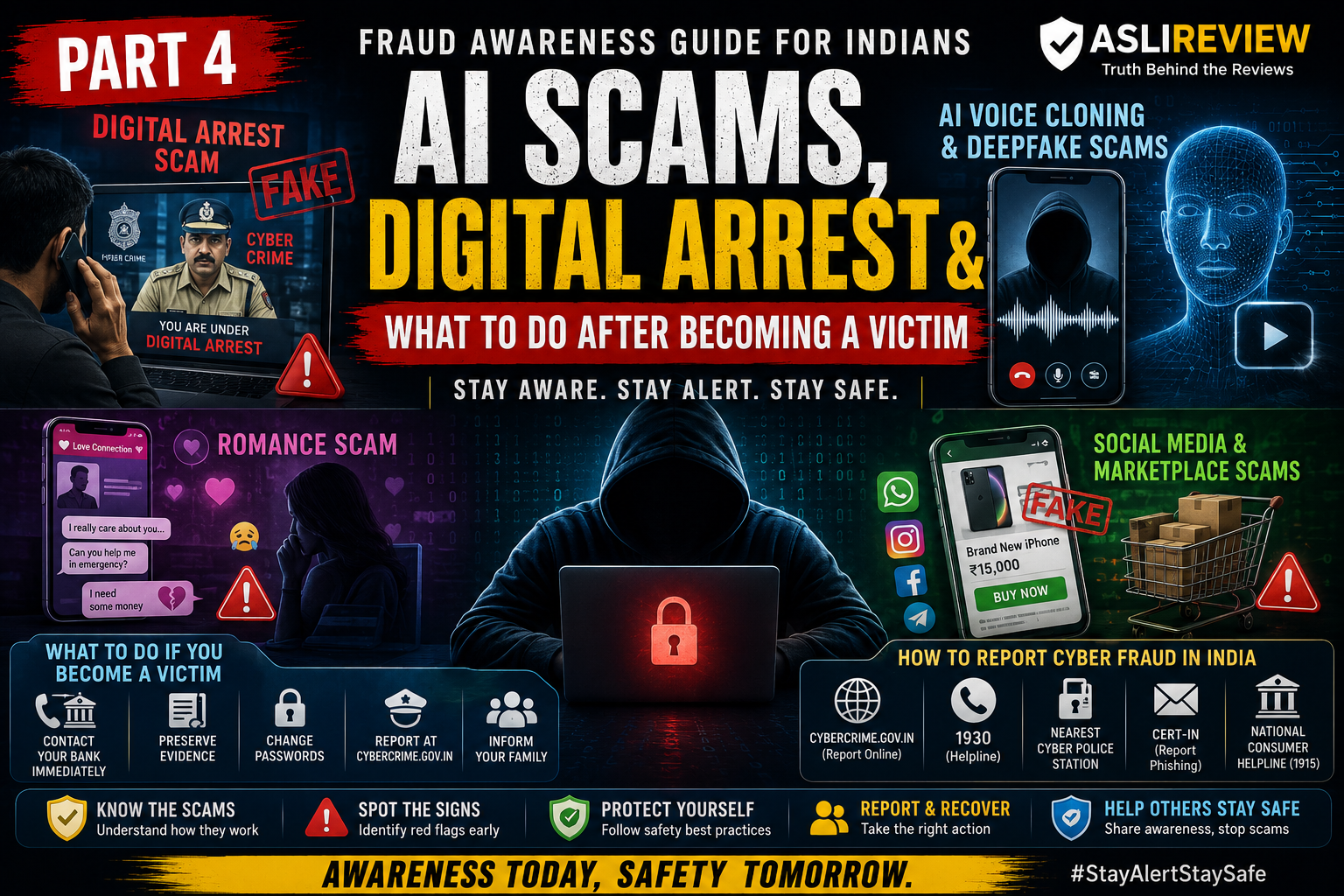
Part 4: AI Scams, Digital Arrest & What to Do After Becoming a Victim
By AsliReview Team · 7 August 2026
Digital Arrest Scam
🚨 Fraud Snapshot
- Category: Impersonation & Financial Fraud
- Risk Level: 🔴 Extremely High
- Common Targets: Professionals, Senior Citizens, Students, Business Owners
- Average Loss: ₹50,000–₹50,00,000+
- Platform: Phone Calls, Video Calls, Messaging Apps
- Difficulty to Identify: High
- Recovery Chances: Moderate if reported immediately
What is a Digital Arrest Scam?
A digital arrest scam is a fraud where criminals pretend to be police officers, cybercrime officials, customs officers, or representatives of government agencies. They falsely accuse the victim of being involved in illegal activities and pressure them to transfer money or reveal sensitive information.
In reality, there is no legal concept of a "digital arrest" in India. Genuine law enforcement agencies do not conduct investigations by asking people to transfer money to a "safe account" or remain on continuous video calls.
How Does This Scam Work?
- You receive a phone or video call from someone claiming to represent a government agency
- The caller says your Aadhaar, SIM card, bank account, or parcel has been linked to a crime
- You are threatened with arrest, account freezing, or legal action
- You are instructed not to disconnect the call or speak to anyone else
- The scammer demands that you transfer money for "verification" or "security"
What Happened?
An accountant received a video call from someone wearing what appeared to be a police uniform. The caller claimed that the accountant's bank account was being used for money laundering and demanded that all savings be transferred to a "government verification account." Believing the caller was genuine, the accountant transferred several lakhs before discovering it was a scam.
⚠️ Warning Signs to Watch For
- Threats of immediate arrest over a phone or video call
- Requests to keep the conversation secret
- Instructions not to contact family members or a lawyer
- Demands to transfer money to a "safe account"
- Caller ID showing a government name but asking for payments
✅ What to Do Instead
- Stay calm and end the call
- Contact the relevant agency using its official contact details
- Never transfer money for "verification"
- Speak with a trusted family member before taking any action
- Preserve call recordings and screenshots if possible
❌ Common Mistakes
- Believing caller ID alone
- Staying on the call for hours out of fear
- Transferring money to unknown accounts
- Sharing Aadhaar, PAN, OTPs, or banking details
🔍 How to Verify
- Contact the agency using official phone numbers from its website
- Verify whether any official notice has actually been issued
- Remember that genuine investigations follow legal procedures, not secret phone calls
💡 AsliReview Tip
Fraudsters want you to panic. The more urgent the demand, the more important it is to pause and verify.
📌 Reality Check
Myth: Police can ask you to transfer money to a secure account over the phone.
Reality: Law enforcement agencies follow legal procedures. They do not ask citizens to move money for verification through phone or video calls.
🛡 Quick Checklist
- Did the caller threaten immediate arrest?
- Was I asked to transfer money?
- Was I told to keep the call confidential?
- Have I independently verified the caller?
If you answered "Yes" to any of these, treat it as highly suspicious.
AI Voice Cloning & Deepfake Scam
🚨 Fraud Snapshot
- Category: AI-Enabled Fraud
- Risk Level: 🔴 High
- Common Targets: Families, Businesses
- Platform: Phone Calls, Video Messages, Social Media
- Difficulty to Identify: High
What is an AI Voice Cloning Scam?
Using artificial intelligence, criminals can create convincing copies of a person's voice from short audio samples available online. They may impersonate a family member, colleague, or employer and urgently request money.
Deepfake technology can also be used to create realistic-looking videos that appear genuine.
How Does This Scam Work?
- The scammer obtains audio or video clips
- AI generates a convincing imitation
- The victim receives a call or message requesting urgent financial help
- The victim acts before verifying the request
⚠️ Warning Signs to Watch For
- Unusual urgency
- Requests for immediate payment
- Poor audio quality or unnatural pauses
- Refusal to switch to a normal phone call or video chat
- Attempts to avoid verification
✅ What to Do Instead
- Call the person back using a known number
- Ask a personal question only the real person would know
- Confirm the request through another communication channel
- Never transfer money based only on a voice message
Romance Scam
🚨 Fraud Snapshot
- Category: Social Engineering
- Risk Level: 🟠 High
- Common Targets: Users of dating apps and social media
- Platform: Dating Apps, Facebook, Instagram
- Difficulty to Identify: Medium
What is a Romance Scam?
A scammer builds an emotional relationship over days or weeks before requesting money for emergencies, travel expenses, gifts, or investments. Some also persuade victims to join fake investment schemes.
⚠️ Warning Signs to Watch For
- Rapid declarations of love or trust
- Refusal to meet in person or join a live video call
- Frequent financial emergencies
- Requests for gift cards, cryptocurrency, or international transfers
✅ What to Do Instead
- Verify the person's identity
- Reverse-search profile photos if something seems suspicious
- Never send money to someone you haven't met and verified
- Discuss concerns with trusted friends or family
Social Media & Marketplace Scams
🚨 Fraud Snapshot
- Category: Online Marketplace Fraud
- Risk Level: 🟠 High
- Common Targets: Buyers and Sellers
- Platform: Facebook, Instagram, WhatsApp, Online Marketplaces
- Difficulty to Identify: Medium
Common Scam Techniques
- Fake seller profiles
- Fake buyer requests
- Payment outside trusted platforms
- Counterfeit products
- Advance payment without delivery
What to Do Instead
- Keep conversations within the official platform
- Avoid paying through unknown methods
- Verify seller reviews
- Inspect products carefully where possible
What Should You Do If You Become a Victim?
The first few hours after discovering a fraud can be critical.
Immediate Steps
- Contact your bank or payment provider immediately
- Block compromised cards or accounts if necessary
- Change passwords and PINs
- Preserve screenshots, messages, emails, and transaction details
- Report the incident through the appropriate official cybercrime reporting channels
- Inform family members if the fraud involves identity theft or impersonation
General Safety Habits
Good cybersecurity is built on everyday habits.
- Use strong, unique passwords
- Enable two-factor authentication where available
- Keep devices and apps updated
- Download apps only from trusted sources
- Avoid clicking unknown links
- Verify before sending money or sharing personal information
Final AsliReview Safety Checklist
Before making any important financial decision, ask yourself:
- Have I verified the person's identity?
- Am I being rushed?
- Is the offer realistic?
- Have I checked independent reviews?
- Have I confirmed details through official sources?
- Would I still make this decision after waiting 30 minutes?
If any answer gives you pause, stop and verify before proceeding.
Conclusion
Fraudsters continuously adapt their methods, but one thing remains constant: they rely on trust, urgency, and emotion to influence their victims.
Whether it's a fake job offer, a UPI request, a digital arrest scam, or an AI-generated voice call, the best defense is taking a moment to verify before acting.
At AsliReview, our goal is not just to help you identify scams—it is to help you make informed decisions. By staying informed, checking independent reviews, and verifying information through trusted sources, you can significantly reduce the risk of becoming a victim.
Awareness is one of the strongest forms of protection. Share this guide with your family and friends so they can recognize these scams before it's too late.
Coming Next: Beyond the Pillar Article
Now that the four-part pillar guide is complete, the next step is to expand each major scam category into dedicated, in-depth articles. These supporting guides will target specific search queries, link back to this pillar page, and strengthen AsliReview's authority as a trusted consumer awareness resource in India.
Report it on AsliReview and help protect others from the same fraud.
🚨 Report a Fraud →