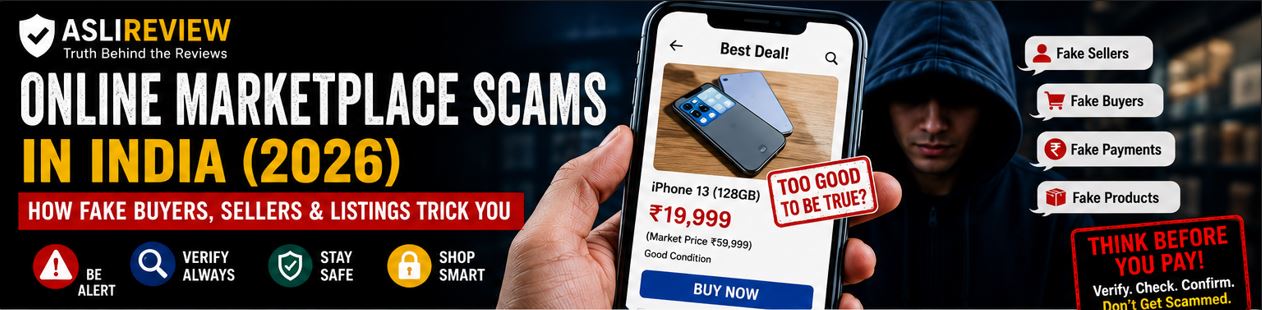
Part 9: Online Marketplace Scams in India (2026): How Fake Buyers, Sellers & Listings Trick You
By AsliReview Team · 24 August 2026
You find the product you've been looking for. The price looks amazing. The seller seems genuine. The profile has photographs. The person answers your messages. Everything feels normal.
Until you pay. Then the seller disappears.
Or perhaps you're the seller. Someone contacts you saying "I'll buy it right now." They send you a payment screenshot. They ask you to scan a QR code. You follow their instructions. And suddenly money leaves your account instead of entering it.
This is the world of online marketplace scams. And it's bigger than simply buying something from a fake website.
Marketplace fraud can happen when you buy a product, sell a product, rent a property, sell a vehicle, buy furniture, purchase electronics, look for a job, search for a service, or respond to a social-media advertisement.
The platform may be completely genuine. The person you're dealing with may not be. That distinction is extremely important.
🚨 Fraud Snapshot
Aslireview Blog8_CommonMarketPlaceScam
Category
E-Commerce & Financial Fraud
Risk Level
🔴 High
Common Targets
Buyers, sellers, vehicle owners, renters, small businesses
Common Channels
Marketplace platforms, social media, WhatsApp, SMS and phone calls
Common Tactics
Fake listings, fake buyers, advance payments, QR codes, fake screenshots and counterfeit products
Difficulty to Identify
Medium to High
Potential Loss
From a few hundred rupees to substantial amounts
Best Protection
Verify the person, product, payment and platform before completing the transaction
What Is an Online Marketplace Scam?
An online marketplace scam is a fraud where someone uses an online buying or selling platform to deceive another person into losing money, receiving a fake or inferior product, revealing sensitive information, or handing over an item without receiving genuine payment.
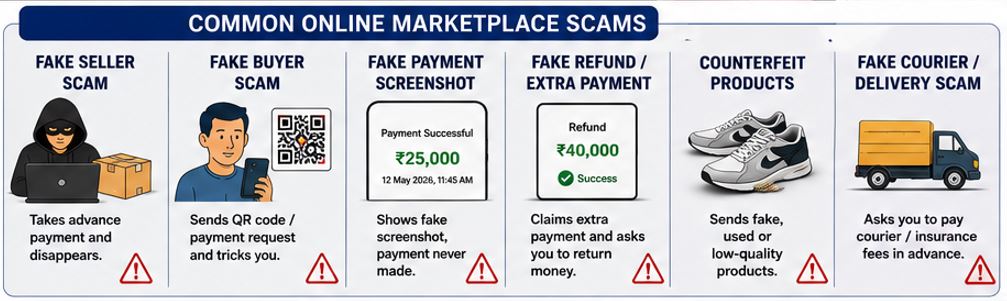
The scammer might pretend to be a buyer, a seller, a dealer, a courier agent, a customer-support representative, a payment representative, a property owner, a vehicle buyer, or a business representative.
The marketplace itself doesn't necessarily have to be fraudulent. Sometimes the scammer simply uses a legitimate platform to find victims.
Why Marketplace Scams Work
Marketplace transactions often involve strangers. You don't know where the person lives, whether their name is genuine, whether the product exists, whether the photographs are theirs, whether the payment is real, or whether the person will disappear after receiving money.
Yet the transaction feels personal because you're chatting directly with someone. That's where scammers take advantage — they try to create trust before verification.
How an Online Marketplace Scam Usually Works
Step 1: A Deal Looks Attractive
The product may be priced below normal market value — for example, an iPhone at ₹28,000 when similar devices are selling for much more.
Step 2: The Scammer Creates Urgency
You hear "I need to sell it today," "I'm relocating tomorrow," "Someone else is interested," or "Pay the advance now and I'll reserve it."
Step 3: You Are Taken Off the Platform
The scammer may say "WhatsApp is easier" or "Let's talk directly." Moving the conversation away from the marketplace can reduce the protection and visibility offered by the platform.
Step 4: Payment Is Requested
You may be asked to pay an advance, a booking fee, a delivery fee, a security deposit, scan a QR code, or transfer money to a personal UPI ID.
Step 5: The Scammer Disappears
The phone is switched off. WhatsApp messages stop showing replies. The listing disappears. The seller blocks you. And your money is gone.
What Happened? A Typical Fake Seller Scam
Let's imagine this situation. Amit finds a used laptop listed for ₹32,000. The seller claims "I'm shifting abroad, so I need to sell it urgently," and sends photographs, a video and even a copy of an ID. Everything looks convincing.
The seller says "Pay ₹5,000 advance and I'll reserve it." Amit transfers the money. The seller then says "The courier requires another ₹2,500." Amit pays again. Then: "Insurance is required." Another payment. Finally, the seller stops responding.
What went wrong? Amit didn't lose money because the laptop was cheap. He lost money because the seller controlled the verification process. Every new problem required another payment.
Aslireview Blog8_WarningSigns
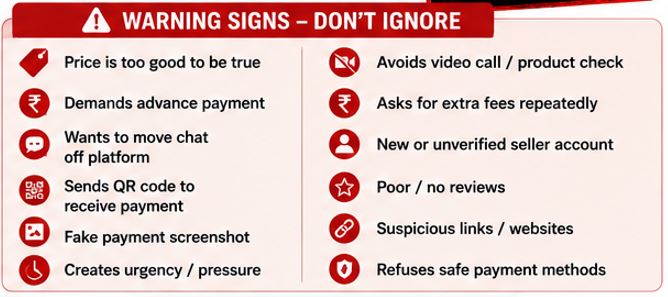
🚩 Warning Sign #1: The Price Is Too Good
A suspiciously low price isn't automatically proof of fraud, but it should trigger additional verification. The National Consumer Helpline advises online shoppers to compare prices and be cautious when an offer is significantly different from similar products elsewhere. It also warns that suspiciously low prices can be associated with counterfeit goods and fraudulent websites.
Compare the price with other marketplace listings, established retailers, manufacturer pricing, used-product prices, and similar products. If the price is dramatically lower, ask why.
🚩 Warning Sign #2: "Pay Now or Someone Else Will Buy It"
This is one of the oldest tricks in the book. The scammer wants you to stop researching. You are told "There are three people interested," "Send ₹2,000 now," or "I'll hold it for you."
If someone creates artificial urgency, slow down. A legitimate seller may genuinely have other buyers, but that doesn't mean you should transfer money without verification.
🚩 Warning Sign #3: The Seller Wants Full Advance Payment
This is particularly risky when you haven't seen the product, the seller has no verifiable business identity, there is no buyer protection, and the transaction is happening outside the platform.
Prefer payment methods and platforms that provide appropriate buyer protections. The National Consumer Helpline recommends using payment methods with buyer protections where possible.
🚩 Warning Sign #4: The Seller Wants to Move to WhatsApp Immediately
You may hear "Send me your WhatsApp number." Moving a conversation to WhatsApp isn't automatically a scam, but it becomes concerning when the person then asks you to pay directly, avoid the marketplace, click an external link, install an app, or scan a QR code.
Keep the transaction within the marketplace's official communication and payment system whenever possible.
🚩 Warning Sign #5: The Product Photos Look Perfect
Scammers can copy photographs from genuine sellers, brand websites, Instagram, other marketplaces, or review websites. A beautiful photograph doesn't prove that the person actually owns the product.
🔍 How to Check Product Photos
Try a reverse-image search. If the same image appears on multiple unrelated listings, foreign websites, different seller profiles, or old advertisements, be careful — it could mean the seller copied the image.
🚩 Warning Sign #6: The Seller Sends an ID Card as "Proof"
This can feel reassuring. The seller might send an Aadhaar image, PAN card, driving licence, employee ID, or business certificate. But a document alone does not prove that the person you're talking to is the genuine owner of that identity.
Treat identity documents as one piece of information, not complete proof. Never share your own identity documents casually just because someone sends theirs.
🚩 Warning Sign #7: The Seller Keeps Adding New Charges
First ₹1,000 advance. Then ₹500 delivery fee. Then ₹2,000 insurance. Then ₹1,500 GST. Then ₹3,000 refundable security. This is a classic escalation pattern.
💡 AsliReview Rule
If every solution creates another payment, stop paying.
🚩 Warning Sign #8: Payment Is Requested to a Different Person
The seller says "Pay my brother's UPI ID," "My company account isn't working," or "Use this agent's account." This doesn't automatically prove fraud, but it deserves verification.
🚩 Warning Sign #9: They Refuse a Normal Verification
You ask "Can I inspect the product?" — they reply "No." You ask "Can we use the marketplace payment system?" — they reply "Only direct payment." You ask "Can we video call and show the product?" — they refuse.
The more verification methods they reject, the more cautious you should become.
🚩 Warning Sign #10: They Ask You to Scan a QR Code
This is especially dangerous for sellers. The scammer may say "I'm sending you the payment. Scan this QR code." But scanning the code can open a payment flow. If you then enter your UPI PIN, you may authorize money leaving your account.
RBI explicitly warns consumers that scanning unknown QR codes and entering a PIN/OTP is not required to receive money.
Fake Buyer Scams: Yes, Sellers Get Scammed Too
Most people think buyer = victim, seller = safe. Not true. Sellers are increasingly attractive targets because they expect to receive money, and scammers exploit that expectation.
What Happened? The Fake Buyer Scam
Ravi lists his old refrigerator for ₹18,000. A buyer contacts him and says "I'll pay immediately," then sends a QR code: "Scan this to receive ₹18,000." Ravi scans it. The UPI screen shows Pay ₹18,000, but he doesn't notice. He enters his UPI PIN. ₹18,000 leaves his account. The buyer then disappears.
The lesson: you don't need to scan a QR code to receive a normal UPI payment.
Fake UPI Payment Screenshot Scam
This is another common seller trap. The buyer sends "Payment Successful — ₹25,000." The screenshot looks convincing. The seller hands over the product. Later, the seller checks the account — ₹25,000 never arrived.
Never release a product based solely on a screenshot, an SMS screenshot, a WhatsApp message, or a "payment successful" message sent by the buyer. Check your actual bank account → UPI transaction history → payment confirmation.
Fake "Refund" From a Buyer
A buyer may claim "I accidentally sent too much" or "I sent ₹40,000 instead of ₹4,000," showing a fake screenshot, then asking you to send the difference back. You send the money. Later you discover the original payment never happened.
💡 AsliReview Tip
Never refund money based solely on a screenshot. Verify the actual credit in your account first.
Fake Courier Pickup Scam
A supposed buyer may say "My courier person will collect the item." The seller is then asked to pay courier charges, pay insurance, scan a QR code, share OTP, or click a link. This can become another payment scam.
If you are selling something valuable, independently verify the courier arrangements. Don't let the buyer's "courier agent" control the payment process.
Fake Marketplace Payment Links
A scammer may send "Use this link to receive your payment." The link might imitate the marketplace and ask you to enter card details, banking credentials, OTP, or UPI information. Don't use payment links sent by strangers — use the marketplace's official payment mechanism.
Fake Product Scams
Not every marketplace scam involves completely fake sellers. Sometimes the seller actually sends something — just not what you ordered. You may receive counterfeit products, used products, damaged products, refurbished products sold as new, wrong models, wrong sizes, empty packages, or low-quality substitutes.
The National Consumer Helpline has documented e-commerce complaints involving wrong products, counterfeit/duplicate products, defective goods, non-delivery and refund problems.
What Happened? The "Original Product" Scam
Neha finds a branded smartwatch listed for ₹4,999. The seller claims "100% original. Brand warranty included." The listing photographs look genuine. The package arrives. Inside is a cheap imitation. The seller refuses the return request. The website becomes unreachable.
Warning signs: the seller refuses to provide a proper invoice, the product serial number cannot be verified, the price is far below normal, the seller has little history, and the product photographs appear copied.
Fake Reviews Are Another Problem
A product can have hundreds of reviews and still deserve careful examination. Look for repetitive wording, reviews posted within a very short period, generic comments, reviews that don't discuss the actual product, sudden bursts of five-star ratings, and reviewer profiles with unusual activity. Don't judge a product solely by the star rating.
💡 AsliReview Tip
This is exactly where AsliReview itself should add value. Instead of simply saying "4.8 stars — great product," we help readers look at what people actually experienced.
Marketplace Scam vs. Bad Seller: Know the Difference
Not every bad shopping experience is a scam. This distinction matters.
A possible consumer dispute: the product arrived late, the seller refused a legitimate return, the product was defective, the refund was delayed, or the wrong item was delivered — these may be consumer grievances rather than deliberate fraud.
Potential fraud: the seller never intended to deliver anything, a fake identity was used, a fake listing was created to collect payments, the buyer used fake payment proof, or the scammer repeatedly demanded money under false pretenses.
The distinction matters because your reporting route may differ.
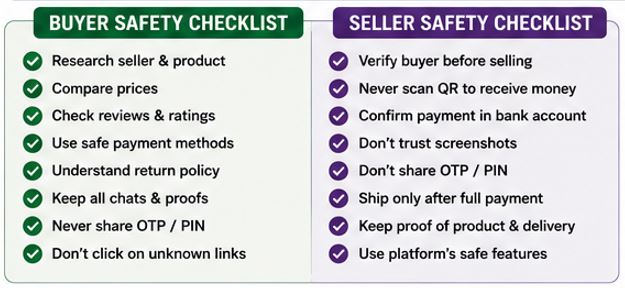
🛡 How to Buy Safely From an Online Marketplace
Step 1: Research the Seller
Check the seller's history, reviews, account age, business details, other listings, and complaints. The National Consumer Helpline recommends researching unfamiliar sellers before purchasing.
Step 2: Compare the Price
If everyone else is selling the product for ₹50,000 and one person offers it for ₹18,000, don't immediately think "Jackpot!" Think "Why is it ₹18,000?"
Step 3: Check the Return Policy
Before paying, understand the return period, refund conditions, replacement rules, warranty, seller responsibility, and shipping arrangements.
Step 4: Check the Seller's Identity
For expensive purchases, ask for reasonable verification — but remember a document can be fake. Don't treat an ID card as absolute proof.
Step 5: Keep Communication on the Platform
If possible, don't move important parts of the transaction outside the marketplace.
Step 6: Use Buyer Protection
Where available, use the marketplace's official payment and dispute mechanisms.
Step 7: Keep Evidence
Save listing screenshots, the seller profile, product photographs, messages, the invoice, payment confirmation, tracking details, and return requests.
🛡 How to Sell Safely on an Online Marketplace
Sellers need their own safety checklist.
Never: trust a payment screenshot, scan a buyer's QR code to receive money, share your UPI PIN, give an OTP to a buyer, pay a "verification fee" to receive payment, or hand over the product before confirming payment.
Always: verify the actual payment, record valuable transactions, meet buyers safely for physical transactions, use platform-provided payment systems where appropriate, and keep proof of delivery.
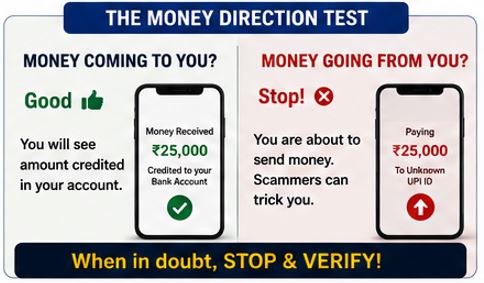
The "Money Direction" Test
Aslireview Blog8_MoneyDirectionChecklist
This is one of our most important AsliReview rules. Whenever someone sends you a payment instruction, ask: is money coming to me or going from me?
If you are selling something and the buyer says "Scan this to receive ₹20,000," and your payment screen says PAY ₹20,000 — stop. You are about to send money.
🚩 Marketplace Scam Red Flags at a Glance
Price dramatically below market — 🔴 High risk
Full advance payment demanded — 🔴 High risk
Seller refuses platform payment — 🔴 High risk
QR code to receive money — 🔴 High risk
Fake payment screenshot — 🔴 High risk
New charges keep appearing — 🔴 High risk
Urgency / pressure — 🟠 Medium–High risk
Refusal to show product — 🟠 Medium–High risk
Brand-new seller account — 🟠 Medium risk
Few or suspicious reviews — 🟠 Medium risk
Moving immediately to WhatsApp — 🟠 Medium risk
One red flag doesn't necessarily prove fraud. Several together should make you walk away.
📌 Reality Check
Myth: The marketplace is genuine, so every seller is genuine.
Reality: A legitimate marketplace can contain individual sellers or listings that require further verification. The platform's existence doesn't automatically prove the identity or honesty of every person using it.
📌 Reality Check
Myth: A buyer cannot scam a seller because the seller is receiving money.
Reality: Fake payment screenshots, QR-code traps and fraudulent payment requests can target sellers specifically. RBI warns that entering a PIN/OTP is not required to receive money.
📌 Reality Check
Myth: A very low price means I found a great deal.
Reality: It could be a great deal. It could also be counterfeit, used, damaged, non-existent, a stolen listing, or a bait price designed to collect an advance. Research before paying.
📌 Reality Check
Myth: The seller sent an Aadhaar/PAN card, so the deal is safe.
Reality: An identity document does not automatically prove that the person you're communicating with is the genuine holder or that the product exists.
How to Verify an Online Marketplace Seller
Before buying an expensive product, ask:
Seller history — is the account established?
Product photos — are the photos original?
Price — is the price realistic?
Identity — can the seller provide reasonable verification?
Payment — can you use a protected payment mechanism?
Product — can you inspect or independently verify it?
Return — is there a genuine return/refund process?
If most answers are yes, risk is lower. If several answers are no, walk away.
What If You Already Paid a Fake Seller?
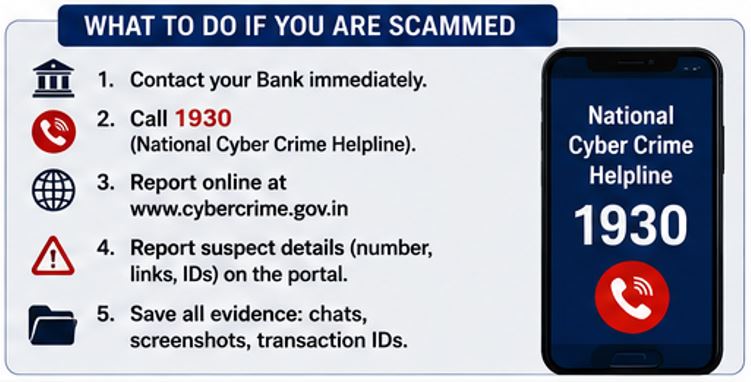
Aslireview Blog8_WhatToDoIfScammed
Act quickly.
Step 1: Save Everything
Take screenshots of the listing, seller profile, messages, phone number, UPI ID, payment confirmation, bank transaction, and product photographs.
Step 2: Contact Your Bank
If money was transferred fraudulently, contact your bank immediately.
Step 3: Call 1930
For financial cyber fraud in India, call 1930 as soon as possible. The National Cyber Crime Reporting Portal provides the official reporting route for cybercrime and financial fraud.
Step 4: Report the Suspect
I4C's National Cyber Crime Reporting Portal has a Report Suspect facility where people can report suspicious website URLs, phone numbers, WhatsApp numbers, Telegram handles, email IDs, SMS numbers/headers, and social-media URLs.
Step 5: Report the Marketplace Listing
Use the platform's own reporting mechanism. Include evidence.
What If You Received a Fake Product?
This is slightly different. Start with the platform's official return/refund process. Keep an unboxing video if available, photos, product packaging, invoice, serial number, seller details, and delivery information.
If the dispute isn't resolved, you can also approach the National Consumer Helpline. The NCH currently provides consumer grievance channels including its portal, app, UMANG and WhatsApp, and its published cases show that e-commerce complaints involving non-delivery, defective products and refunds can be escalated through its system.
National Consumer Helpline
For a consumer grievance that isn't necessarily a cybercrime — for example, a wrong product, defective product, non-delivery, refund not provided, return dispute, or service deficiency — the National Consumer Helpline (NCH) can be an appropriate route.
The current NCH service lists 1915 as its toll-free number and provides online and other grievance channels. This is different from 1930, which is the national helpline associated with reporting financial cyber fraud.
Don't assume distance means you cannot take action. Preserve the seller's identity, contact details, payment information, platform information, listing, messages, and delivery information — then use the appropriate platform, bank, consumer and cybercrime reporting channels.
The AsliReview 5-Point Marketplace Test
Before paying a new seller, ask:
Is the price realistic?
Can I verify the seller?
Can I verify the product?
Can I use a protected payment method?
What happens if something goes wrong?
If you don't have a satisfactory answer to several of these questions, don't buy.
💡 AsliReview Tip — Never Let a Bargain Make the Decision for You
Scammers know exactly what a good deal feels like. That's why the price is often the first weapon. When you see a ₹60,000 product for ₹19,999, don't ask "How quickly can I buy this?" Ask "Why is it ₹19,999?" That tiny change in thinking can save you a lot of money.
🛡 Quick Marketplace Safety Checklist
Before buying:
Seller has a believable history
Product photos appear genuine
Price is realistic
Seller details can be verified
Return/refund policy is clear
Payment method offers appropriate protection
Seller isn't pressuring me
Before paying:
I'm paying the correct person/business
Amount is correct
I'm not being asked for unnecessary fees
I'm not being redirected to a suspicious website
I'm not sharing OTP/PIN/passwords
I'm not scanning an unknown QR code
Before accepting payment as a seller:
Money appears in my actual account
I didn't rely on a screenshot
I didn't scan a buyer's QR code
I didn't share my UPI PIN
I didn't hand over the product before confirming payment
Frequently Asked Questions
Is every cheap marketplace listing a scam?
No. Some sellers genuinely offer discounts. But an unusually low price should trigger additional verification. The National Consumer Helpline specifically advises consumers to be cautious when prices are significantly lower than comparable products.
Can a buyer scam a seller?
Yes. Common methods include fake payment screenshots, fake UPI requests, QR-code scams, fake refund claims, and fake courier charges.
Can I trust a seller who has good reviews?
Reviews can be useful, but they shouldn't be your only verification method. Look at the seller's history, product details, pricing, return policy and payment method as well.
Should I pay an advance to an online seller?
There is no universal rule that every advance payment is fraudulent. But paying a stranger in advance — especially outside the marketplace's protected payment system — can significantly increase your risk.
Is WhatsApp payment safe?
WhatsApp itself doesn't make a transaction safe or unsafe. The important question is who you're paying, why you're paying, and what protection exists if something goes wrong.
Can a seller ask me to scan a QR code to receive money?
Be very careful. RBI warns that entering a PIN/OTP is not required to receive money. If scanning a QR code opens a payment screen requiring you to authorize a payment, stop.
Is a payment screenshot proof that the buyer paid?
No. Check your actual bank or payment account.
What if the seller sends me an Aadhaar card?
Don't treat an identity document as complete proof of trust. The document could be misused, altered or belong to someone other than the person you're communicating with.
What if I receive a counterfeit product?
Document the issue immediately. Take photographs, preserve packaging and invoice details, initiate the platform's return/refund process and, where appropriate, approach the National Consumer Helpline. NCH has published multiple e-commerce cases involving defective, wrong and counterfeit products.
Where should I report online marketplace fraud?
If money has been lost through cyber fraud, report it immediately through 1930 and the National Cyber Crime Reporting Portal. You should also report the fraudulent listing/account to the marketplace. For consumer grievances such as defective products, non-delivery or unresolved refund disputes, the National Consumer Helpline can be another appropriate route.
Can I report a suspicious marketplace URL even if I haven't lost money?
Yes. I4C's National Cyber Crime Reporting Portal has a Report Suspect facility for suspicious URLs, phone numbers, WhatsApp/Telegram handles, email IDs, SMS identifiers and social-media URLs.
Related AsliReview Guides
This article connects closely with AsliReview's guides on UPI fraud (fake payment requests), QR code scams (fake buyer QR codes), fake customer care scams (scammers impersonating marketplace support), and fake refund scams (payment reversal tricks) — together forming a growing topical cluster on digital-payment fraud.
Final Word
Online marketplaces have made buying and selling incredibly convenient. You can sell an old phone from your bedroom, buy furniture from another city, find a used car, order electronics, or sell something you no longer need.
But there's one thing you should never forget: you are often dealing with a stranger.
The platform may be real. The listing may look real. The photographs may be real. The conversation may feel real. And the person may still be a scammer.
So don't let a good price replace verification. Don't let urgency replace thinking. Don't let a payment screenshot replace your bank account. And don't let someone else's instructions control your UPI transaction.
For buyers: verify the seller, verify the product, verify the payment.
For sellers: verify the payment before handing over the product.
And if something goes wrong: save the evidence, contact your bank, call 1930 if it is financial cyber fraud, report the marketplace account/listing, and use 1915/National Consumer Helpline for appropriate consumer grievances.
The National Consumer Helpline's published cases show that online shopping disputes — including non-delivery, defective products and refund problems — can sometimes be resolved through consumer grievance mechanisms.
The smartest marketplace shopper isn't the person who finds the cheapest deal. It's the person who knows when a deal isn't worth the risk.
Aslireview Blog8_Footer
Been cheated by a vendor?
Report it on AsliReview and help protect others from the same fraud.