Instagram Shopping Scam: How a ₹1,500 Saree Became a ₹1.19 Lakh Fraud
By AsliReview Team · 2 October 2026
Instagram Shopping Scam: How a ₹1,500 Saree Became a ₹1.19 Lakh Fraud
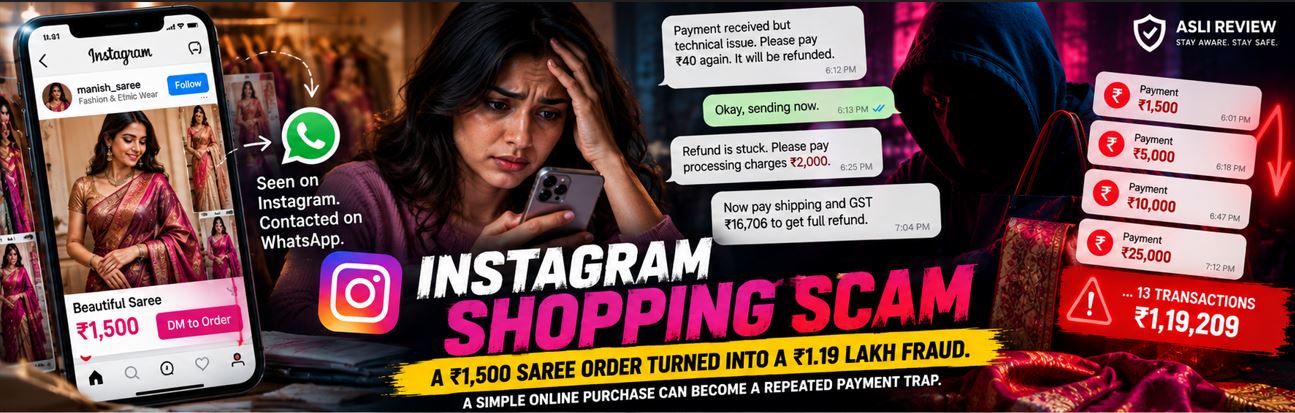
You see a beautiful saree on Instagram, priced at a reasonable ₹1,500. You message the seller on WhatsApp and pay. Then a message arrives: "There is a technical issue. Please make another small payment — we will refund it." You pay again. Then another problem appears. Then GST. Before you realise what's happening, a ₹1,500 purchase has turned into a cyber-fraud case worth lakhs.
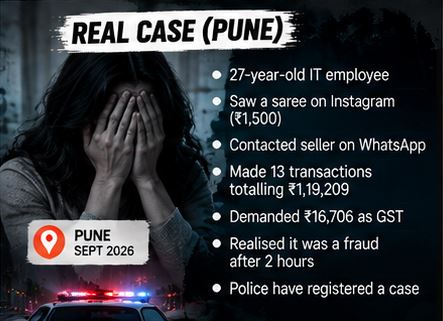
That is reportedly what happened to a 27-year-old IT employee in Pune, who transferred ₹1,19,209 across 13 transactions over roughly two hours while trying to buy a saree promoted through Instagram accounts named "manish_saree" and "manish_saree_9." An FIR was registered at Hinjewadi police station, and the suspects were reportedly being traced through their phone numbers, bank accounts, and Instagram profiles.
AsliReview_InstagramShoppingScam_RealCase
AsliReview Editorial Note: This case is reported as described in the source material shared with us; we were not able to independently re-confirm every detail through our own search, so treat the specific figures as "as reported" rather than independently verified by us. The underlying fraud *pattern* — escalating "refund" payments after a small initial purchase — is well documented across many similar cases in India and is the real lesson here.
Repeated "refund" and "verification" payment demands
How It Works
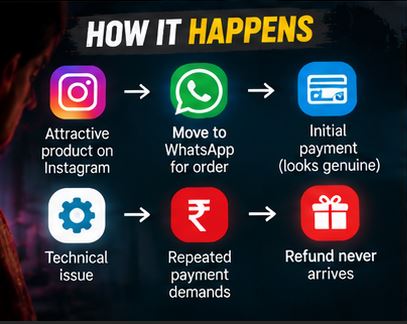
AsliReview_InstagramShoppingScam_HowItHappens
1. An attractive, not unbelievable, price appears in a Reel, post, or story — believable enough that it doesn't trigger suspicion the way an absurd discount would.
2. You're moved off-platform to WhatsApp, where the seller sends a bank account or UPI ID directly — skipping any checkout protection a marketplace would normally provide.
3. You pay the advertised amount. Everything still feels normal.
4. A "technical issue" appears. You're asked for a small extra payment — often just ₹40–500 — with a promise it will be refunded. The smallness is deliberate: it's designed to feel harmless.
5. The refund never arrives. Instead, a new reason appears: verification, processing, shipping, insurance, or GST — each framed as the final step before your money (and the refund) is released.
6. The sunk-cost trap sets in. Having already paid ₹5,000, you think "I just need to pay ₹2,000 more to get it all back." That logic is what keeps the payments coming.
Why It Works
The entry price is small enough to feel low-risk — you're not thinking "I'm taking a financial risk," you're thinking "I'm just buying a saree."
Each new demand is framed as recoverable, not as a loss — "pay a little more and we'll refund everything" feels completely different from "give me more money," even though the financial result is identical.
A polished Instagram page substitutes for real verification. Good photos, reels, and comments can make a page look like a genuine boutique — but none of that is proof of a legitimate, accountable business.
Official-sounding terms like GST are used to make an extra charge sound routine rather than suspicious.
Warning Signs
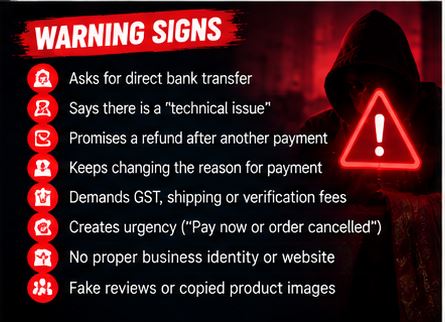
AsliReview_InstagramShoppingScam_WrningSigns
The seller asks you to pay by direct bank transfer or UPI instead of a recognised checkout
You're pushed from Instagram to WhatsApp for the actual transaction
After paying, a "technical issue," "refund problem," or "verification" appears, asking for another payment
You're told the new payment is fully refundable along with the original amount
The reason for each new payment keeps changing (technical → refund → shipping → GST)
There's pressure to pay quickly ("offer ends today," "pay within 10 minutes")
Reality Check
Myth: "A scam only starts with suspiciously cheap products." Reality: this one started with an ordinary ₹1,500 saree — the initial price can look completely reasonable.
Myth: "Lots of followers and comments mean the seller is real." Reality: followers and comments aren't independent proof of a legitimate business.
Myth: "If I've already paid, I should pay once more to unlock the refund." Reality: a refund should reduce what you've paid, not require you to keep paying the person who already has your money.
Myth: "GST means the demand must be legitimate." Reality: scammers use official-sounding terms precisely because they sound legitimate — ask for a proper invoice and GSTIN before paying.
What To Do
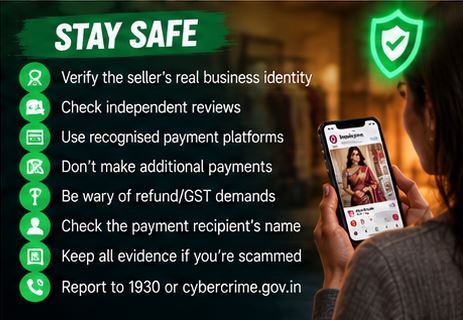
AsliReview_InstagramShoppingScam_StaySafe
1. Stop at the first unexplained extra payment request. A genuine purchase shouldn't require a second, unrelated transfer.
2. Verify the payment recipient's name shown in your UPI/banking app against the business name the seller claims to be.
3. If you've already lost money, don't wait: contact your bank immediately, and call the National Cyber Crime Helpline at 1930 or file at cybercrime.gov.in.
4. Preserve evidence — the Instagram profile, chat, phone number, UPI ID/bank details, and transaction IDs — before anything is deleted.
5. Don't let embarrassment delay reporting. The victim here was an IT professional buying an ordinary product online, not someone being careless — the scam is built to work on anyone.
Frequently Asked Questions
Is shopping through Instagram always risky?
No. Many legitimate businesses sell through Instagram. The risk is in skipping independent verification of the seller, the payment recipient, and the refund process before paying.
Why do sellers ask for payment again right after I've already paid?
Because you've already shown willingness to pay once — the "technical issue" or "refund" story is designed to extract a second (and third, and fourth) payment while you're still trying to complete the original purchase.
What should I do if an Instagram seller asks for GST after I've already paid?
Don't pay it automatically. Ask for a proper invoice and GSTIN, and treat repeated demands to "unlock" a refund or delivery as a clear warning sign.
Where do I report this kind of fraud?
Call 1930 (National Cyber Crime Helpline) or file at cybercrime.gov.in as soon as possible, and contact your bank immediately to flag the transactions.
---
*Source: reported as shared with us, attributed to Pune Police and media coverage of the Hinjewadi case. Specific figures are presented as reported and have not been independently re-verified by us.*
AsliReview Tip: Your first payment should never become a commitment to make a second one. If a seller says "just pay a little more and we'll refund everything," that's the moment to stop — not the moment to trust them more because you've already paid.
Been cheated by a vendor?
Report it on AsliReview and help protect others from the same fraud.