Honey Trap 2.0: How Strangers on Dating, Shopping & Social Apps Can Turn Into an Extortion Trap
By AsliReview Team · 25 September 2026
You don't have to be looking for romance to become a honey-trap target. You could be using a dating app. You could be buying or selling something on an online marketplace. You could simply be chatting with someone on social media.
A normal-looking conversation can slowly build trust, lead to a private meeting — and in some reported cases, turn into extortion, kidnapping, assault or robbery. A recent Delhi case shows just how far this type of crime can go.
🚨 Fraud Snapshot
Scam Type
Honey trap / social engineering / extortion
Entry Points
Dating apps, marketplace apps, social media
Main Tactic
Manufactured trust followed by isolation
Possible Outcome
Extortion, robbery, kidnapping or assault
Recent Case
Delhi, September 2026
Amount Demanded
₹70 lakh
Key Lesson
Don't just verify the person — verify the situation
The phrase "honey trap" often makes people think of dating apps. But modern criminals don't necessarily need romance — they need trust. And trust can be created almost anywhere.
A person may approach you through Tinder or another dating platform, a marketplace app, Instagram or Facebook, WhatsApp, a buying or selling platform, a social community, or even a seemingly ordinary business interaction. The conversation may initially appear completely normal. Then comes the meeting — and that's where the situation can change.
AsliReview_HoneyTrap2.0_MarketPlaceTrapApp
What Happened in the Recent ₹70 Lakh Delhi Case?
AsliReview_HoneyTrap2.0_RealCase
In September 2026, Delhi Police reported a case involving a Gurgaon-based employee of a multinational company.
According to police, a woman and her husband were operating an account on an online marketplace application. The woman allegedly contacted the victim under the pretext of purchasing household goods. The two agreed to meet, and the woman allegedly called the man to a flat in Neb Sarai, South Delhi.
Police said that after he arrived, the woman's husband and other associates allegedly confined and assaulted him and demanded ₹70 lakh. The victim was allegedly taken through parts of Haryana and Uttar Pradesh in his own SUV. Police later traced him to Mathura and rescued him. Six people were arrested in connection with the case, and police reported recovering the victim's vehicle, phone, cards, identity documents and other belongings.
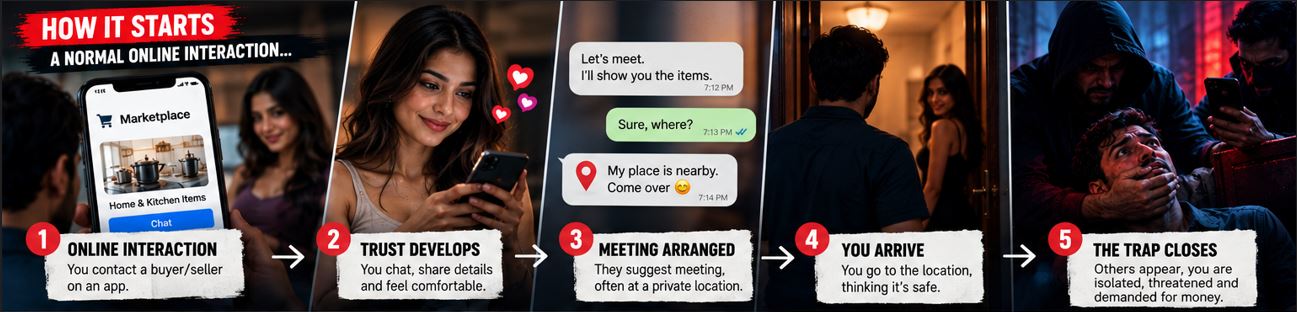
These are allegations reported by police — the investigation and legal proceedings determine responsibility. The important lesson isn't the specific app. It is the sequence: online contact → trust → meeting → isolation → control → extortion. That pattern is worth understanding.
This Isn't Just a Dating-App Problem
Earlier in 2026, Delhi Police also busted an alleged honey-trap and extortion racket involving fake female profiles on Tinder and QuackQuack. According to police, victims were contacted through fake profiles and encouraged to meet, then allegedly taken to rented flats or isolated locations where other members staged fake police raids.
One reported victim was allegedly threatened with a false criminal case and faced a demand for ₹15 lakh. Police said one accused even impersonated a police officer during the alleged extortion attempt.
The case shows another version of the same basic pattern: attraction → meeting → isolation → fear → extortion.
Honey Trap 2.0: The New Attack Pattern
Traditional honey traps often relied heavily on romance or sexual attraction. Modern versions can be much broader.
AsliReview_HoneyTrap2.0_HowItStart
Step 1: The Stranger Appears Normal
The profile may look ordinary — photographs, conversations, product listings or apparently genuine personal information.
Step 2: Trust Develops
The criminal doesn't necessarily ask for money immediately. Instead, they create familiarity. You chat, exchange messages, discuss common interests, and may even have several conversations before meeting.
Step 3: The Meeting Becomes the Objective
Eventually comes "let's meet." Sometimes the meeting is initially suggested in a public place. Then the plan changes: "come here instead," "my place is nearby," "let's go somewhere quieter." That change can be a major warning sign.
Step 4: Isolation
Once the victim is away from public view, the power balance can change dramatically. Other people may suddenly appear. A door may be locked. The person's phone, wallet or vehicle may be taken. Threats may begin.
Step 5: Fear Replaces Trust
This is where the scam can turn into extortion. The victim may be threatened with false criminal allegations, videos or photographs, exposure to family or colleagues, physical violence, kidnapping, police involvement, or financial consequences.
Step 6: Money Is Demanded
The criminals may demand cash, bank transfers, UPI payments, ATM withdrawals, jewellery, credit-card transactions, or transfers from friends or relatives. The objective is simple: turn fear into money.
Why Do These Scams Work?
Because the criminal isn't necessarily attacking technology — they're attacking human decision-making.
Manufactured familiarity — a stranger becomes familiar after repeated conversations, creating a false sense of safety.
Curiosity — the victim wants to know who the person really is, encouraging the first meeting.
Social pressure — once plans are made, cancelling can feel awkward; people sometimes ignore their own doubts because they don't want to appear rude.
Isolation — the criminal may gradually move the interaction away from public spaces.
Fear — once the victim is isolated, threats can override rational thinking.
This is why honey-trap crimes can become much more serious than ordinary online scams.
The Biggest Red Flag: A Sudden Change of Plan
Imagine you agree to meet someone at a busy café. Everything seems normal. Then you receive "actually, let's meet at my flat, it's just nearby." That's the moment to stop — not because the person is necessarily a criminal, but because the risk has changed.
A public location gives you other people around, CCTV, easy transportation, a natural exit, and greater personal safety. A private flat removes many of those protections.
AsliReview Rule: if the meeting location suddenly changes from public to private, don't follow automatically. You can simply say "let's meet at the original location." Their reaction can tell you a lot.
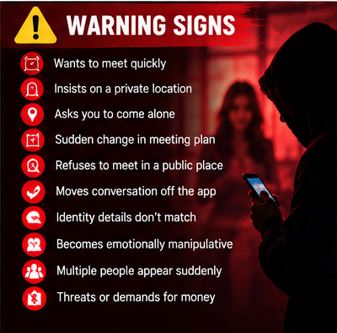
Warning Signs to Watch For
AsliReview_HoneyTrap2.0_WarningSigns
Be particularly cautious when several of these signs appear together:
Someone wants to meet very quickly
They insist on meeting privately
They ask you to come alone
They discourage you from telling anyone
They suddenly change the meeting location
They repeatedly push you off the original platform
Their identity details don't remain consistent
Their photographs or information seem difficult to verify
They become unusually emotional when you hesitate
Several unknown people suddenly appear
Someone starts recording you without explanation
Someone takes control of your phone, wallet or vehicle
Threats begin immediately after the meeting
You are asked to transfer money to "settle" a situation
Someone claims you will face criminal action unless you pay immediately
One warning sign doesn't automatically mean fraud. A cluster of warning signs is what should make you step back.
The Public Meeting Rule
If you're meeting someone you've only known online, your first meeting should be a public place — busy cafés, restaurants, shopping malls, well-populated public areas, places with CCTV and staff. Avoid unknown flats, isolated houses, empty buildings, remote roads, private hotel rooms, unfamiliar locations, or any place where you cannot easily leave. Keep your own transportation whenever possible.
Tell One Person
This simple step can make a huge difference. Before meeting someone new, tell a trusted person who you're meeting, where you're going, approximate meeting time, how you'll return, and the person's profile/contact details. You can also share your live location during the meeting. It isn't paranoia — it's a basic safety layer.
Don't Let Someone Else Control Your Exit
One of the most important principles is independent movement. If you meet someone for the first time: keep your phone with you, keep your wallet/cards with you, don't hand over identity documents, don't give someone control of your vehicle, avoid consuming anything that impairs your judgment, maintain your own transportation option, and don't allow an unexpected change of location to happen automatically. Your ability to leave is a safety mechanism.
What If the Situation Suddenly Turns Threatening?
This is where many people make a dangerous mistake — they try to argue, try to prove they're right, try to negotiate aggressively, or try to fight several people at once.
If you are facing multiple people or immediate physical danger, your priority should be getting to safety, not winning the argument. If you can safely leave, move toward a populated area. If you are in immediate danger, contact the police/emergency services. If money has already been transferred as part of an online financial fraud, report it immediately through India's cybercrime reporting system and the 1930 helpline.
What If Someone Threatens You With a False Case?
This is an important part of modern extortion scams. A criminal may say "pay us or we'll file a case against you." The threat itself can create panic — victims may think "if I don't pay, my life is finished." That fear can make them transfer large amounts of money.
Don't assume the threat is legitimate. If someone claims to be a police officer or government official: don't blindly transfer money, don't surrender your phone because someone demands it, don't rely on a stranger's instructions, move to a safe location if possible, contact the police directly through an official channel, and preserve messages, numbers, payment records and other evidence.
Don't Delete the Evidence
If you suspect you've been targeted, preserve everything — screenshots, chat history, profile links, phone numbers, payment records, UPI IDs, bank transaction details, vehicle information, hotel/restaurant details, photos or videos, threat messages, and call logs. Don't delete the conversation simply because it is embarrassing — that evidence may become important later.
The 5-Second Honey Trap Test
Before meeting someone you've only known online, ask yourself:
Who exactly is this person? Can their identity reasonably be verified?
Why are they insisting on this meeting? Is there a genuine reason?
Why this location? Is it public and easy to leave?
Why am I being asked to come alone? If there is no good reason, take a step back.
What happens if this person isn't who they claim to be? This is the most important question.
You don't need to prove that someone is dangerous. You simply need to make sure that your safety doesn't depend on them being trustworthy.
The AsliReview 10-Point Honey Trap Safety Checklist
Before meeting someone you've met online:
Meet in a public place
Tell someone you trust
Share your location
Keep your own transportation
Keep your phone with you
Don't hand over cards or identity documents
Don't suddenly change to an isolated location
Don't allow strangers to control your movement
Preserve suspicious messages and payment records
Leave immediately if the situation becomes threatening
📌 Reality Check
Myth: Honey traps only happen on dating apps.
Reality: Recent Delhi reporting shows that an alleged honey-trap operation also used an online marketplace interaction as the entry point.
📌 Reality Check
Myth: If the profile looks real, the person is real.
Reality: A convincing online identity doesn't prove that the person is trustworthy.
📌 Reality Check
Myth: If we've chatted for weeks, they're safe.
Reality: Time spent communicating online is not the same as independently verifying someone's identity.
📌 Reality Check
Myth: Only people looking for romance get honey-trapped.
Reality: The recent marketplace case reportedly began with a household-goods interaction rather than a dating proposition.
📌 Reality Check
Myth: I can handle it if something feels wrong.
Reality: Extortion situations can involve multiple people, threats and physical force. Prevention and early exit are much safer than trying to control the situation after it escalates.
The Bigger Lesson: Trust Is Not Verification
This is probably the most important lesson from modern honey-trap scams. We often ask "do I trust this person?" Ask a better question: "What independent evidence do I have that this situation is safe?"
Those are two very different questions. Someone can appear friendly. Someone can appear attractive. Someone can appear genuine. Someone can have a believable profile. Someone can have hundreds of followers. None of those things guarantee your safety.
The Honey Trap Has Changed
The biggest mistake is thinking "this could never happen to me because I don't use dating apps." The Delhi case shows why that assumption is outdated.
The first contact can happen through an ordinary marketplace. The trust can develop through social media. The meeting can look completely normal. And the criminal element may only become obvious after the victim is isolated. That's why modern fraud awareness isn't just about spotting fake websites or suspicious links — sometimes the most dangerous part of a scam is another human being.
What to Remember
Online contact is not the danger. Blind trust is the danger. Private meetings with strangers create unnecessary risk. Sudden changes of location deserve attention. Threats and demands for money should never be handled casually.
And most importantly: don't ask only "can I trust this person?" Ask "have I made this situation safe even if I can't?" That's the mindset that can stop a conversation from becoming a crime story.
Frequently Asked Questions
What is a honey trap scam?
A honey trap scam generally involves manipulating a person through attraction, trust or a seemingly personal relationship and then using the situation for extortion, robbery or another crime. The term is used broadly in media and law-enforcement reporting and can involve different criminal methods.
Can honey traps happen through marketplace apps?
Yes. A September 2026 Delhi case reported by police involved an alleged honey-trap operation that began through an online marketplace account used to discuss household goods.
Are dating apps unsafe?
Dating apps themselves are not inherently unsafe. The risk comes from specific behaviours such as fake identities, pressure to meet privately, isolation, threats or requests for money.
Should I meet an online contact at their home?
For a first meeting with someone you have only known online, a public location is a safer choice than a private residence.
What should I do if someone threatens me for money?
Prioritise your physical safety, avoid escalating the confrontation, preserve evidence and contact the police. If the incident involves online financial fraud, report it promptly through the appropriate cybercrime channels.
Can women also become victims?
Absolutely. Honey-trap and extortion crimes are not inherently gender-specific. Anyone can become a target.
Is meeting someone from an app itself dangerous?
No. Meeting people through online platforms is now a normal part of modern life. The key is reducing avoidable risk through public meetings, independent transportation, verification and letting someone you trust know where you are.
💡 AsliReview Tip
Your first meeting should always be designed so that you can leave easily: public place, your own transport, someone knows where you are, your phone stays with you. If a stranger becomes angry simply because you want basic safety precautions, you don't need to prove anything — just leave.
AsliReview_HoneyTrap2.0_Footer
Been cheated by a vendor?
Report it on AsliReview and help protect others from the same fraud.