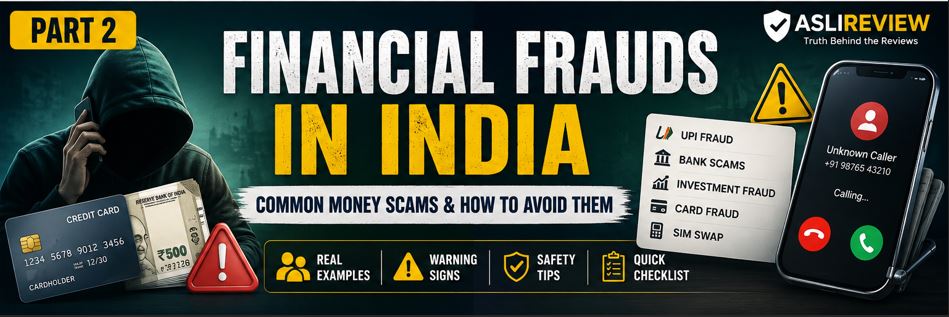
Part 2 Financial Frauds in India – The Most Common Money Scams
By AsliReview Team · 30 July 2026
Financial frauds account for a large share of cybercrime complaints in India. These scams target your bank account, digital wallets, UPI apps, debit cards, credit cards, or investments. In many cases, victims lose money within minutes because fraudsters create a sense of urgency and panic.
The good news is that most financial scams follow predictable patterns. Once you understand how they work, you can spot the warning signs before it's too late.
1. UPI Fraud
What is UPI Fraud?
UPI (Unified Payments Interface) has made digital payments simple and fast. Unfortunately, it has also become one of the most common targets for scammers.
Instead of hacking your bank account, fraudsters usually trick you into approving a transaction yourself.
How Does It Work?
A scammer may:
- Pretend to be a buyer for an item you're selling
- Send a fake payment screenshot
- Ask you to scan a QR code to "receive" money
- Send a "Collect Request" and ask you to approve it
- Pose as customer support from a payment app
- Claim you've won cashback or a prize
Many people mistakenly believe that scanning a QR code always means receiving money. In reality, it can authorize a payment from your account.
Example
Rahul listed his old laptop for sale online. A buyer agreed to pay ₹35,000 and sent a QR code, saying it was needed to receive the payment. Rahul scanned the code and entered his UPI PIN. Instead of receiving money, ₹35,000 was deducted from his account.
🚩 Red Flags
- Asked to scan a QR code to receive money
- Asked to enter your UPI PIN before receiving payment
- Fake payment confirmation screenshots
- Requests to complete payment outside trusted platforms
- Pressure to act quickly
How to Stay Safe
- Never enter your UPI PIN to receive money
- A genuine sender does not need your PIN
- Carefully read every UPI notification before approving it
- Verify payment by checking your bank account or UPI app, not screenshots
- Enable transaction alerts
✅ AsliReview Tip
Remember this simple rule: your UPI PIN is only required when sending money, never when receiving it.
2. QR Code Scam
What is a QR Code Scam?
QR codes have become common in shops, restaurants, and online transactions. Fraudsters misuse this familiarity by sending fake QR codes or replacing genuine ones.
Common Scenarios
- Fake online buyers
- Fake charity donations
- Fake restaurant payment codes
- Tampered QR stickers in stores
- Fake refund processing
Example
Priya contacted a fake customer care number found through an online search. The executive claimed to process her refund and asked her to scan a QR code. Within seconds, ₹12,000 was deducted from her account.
Warning Signs
- QR code shared through WhatsApp
- Unknown person requesting a scan
- QR code received after asking for a refund
- Instructions to enter your UPI PIN
Safety Tips
- Scan QR codes only from trusted merchants
- Confirm the recipient's name before paying
- Do not trust QR codes shared by strangers
- Report suspicious QR stickers to the shop owner
3. Fake Bank Call Scam
How Does It Work?
Someone calls claiming to be from your bank.
They may say:
- Your account will be blocked
- Your KYC has expired
- Your debit card has been suspended
- Suspicious activity has been detected
To "verify" your account, they ask for:
- OTP
- Debit card number
- CVV
- Net banking credentials
- UPI PIN
Once shared, the scammer uses the information to transfer money.
Reality Check
Banks do not ask for OTP, UPI PIN, ATM PIN, CVV, or your internet banking password over phone calls, emails, SMS, or WhatsApp.
Example
An elderly customer received a call claiming his KYC had expired. Believing the caller was genuine, he shared the OTP sent to his phone. Within minutes, multiple unauthorized transactions emptied his account.
Safety Tips
- Disconnect the call
- Call the bank using the official number printed on your card or available on its official website
- Never trust caller ID alone; numbers can be spoofed
4. Fake Customer Care Scam
Many people search Google for customer care numbers.
Fraudsters exploit this by creating fake listings with their own phone numbers.
When victims call:
- They pretend to help
- Ask users to install remote access apps
- Request OTPs
- Ask users to share screens
- Convince them to approve transactions
Common Targets
- Banks
- Payment apps
- Food delivery apps
- Airlines
- Telecom companies
- E-commerce platforms
AsliReview Checklist
Before calling customer support:
- Visit the company's official website
- Use customer care numbers from official apps
- Ignore numbers shared in random comments or social media posts
5. Credit Card Fraud
Credit card scams continue to evolve. Common methods include:
Card Skimming — Fraudsters secretly install devices on ATMs or payment terminals to copy card information.
Phishing — Victims receive fake emails asking them to "verify" their card details.
Fake Reward Points — Scammers claim your reward points are about to expire and ask you to share sensitive information.
Contactless Fraud — If a card is lost and contactless payments are enabled, small purchases may be possible before the card is blocked.
Safety Tips
- Enable transaction alerts
- Lock your card when not in use (if your bank provides this feature)
- Regularly review your statements
- Report unauthorized transactions immediately
6. ATM Fraud
Although digital payments have grown, ATM scams still occur. Examples include:
- Card skimming
- Hidden cameras recording PINs
- Fake ATM keypads
- Card trapping devices
Safety Tips
- Cover the keypad while entering your PIN
- Avoid ATMs that appear damaged or unusual
- Seek assistance only from bank staff, not strangers
- Report any suspicious equipment to the bank
7. SIM Swap Fraud
What is SIM Swap Fraud?
A fraudster obtains a duplicate SIM card for your mobile number, often through identity theft or social engineering.
Once they control your number, they can receive:
- OTPs
- Banking alerts
- Password reset codes
This allows them to take over your financial accounts.
Warning Signs
- Sudden loss of mobile network without explanation
- Unexpected messages about SIM activation
- Banking alerts you didn't trigger
What Should You Do?
If your SIM suddenly stops working:
- Contact your mobile operator immediately
- Contact your bank
- Freeze digital banking access if necessary
- Change important passwords after recovering your number
8. Investment Fraud
Everyone wants to grow their money. Scammers take advantage of this by promising unusually high returns with little or no risk.
Common examples include:
- Fake stock advisory groups
- Cryptocurrency investment scams
- Forex trading scams
- Ponzi schemes
- MLM schemes disguised as investment opportunities
- Fake mutual fund advisors
Reality Check
There is no legitimate investment that guarantees extremely high returns without risk.
Promises like "double your money in 30 days," "guaranteed 10% monthly returns," or "risk-free investment" should immediately raise suspicion.
Example
A Telegram group claimed to offer exclusive stock tips with guaranteed profits. Members were encouraged to invest larger amounts after receiving small initial returns. Once significant funds were deposited, the administrators disappeared.
Before Investing
Ask yourself:
- Is the company properly registered?
- Can I independently verify its claims?
- Are returns realistic?
- Is there unnecessary pressure to invest immediately?
- Can I withdraw my money easily?
If the answer to any of these questions is "no," reconsider the investment.
🚩 AsliReview Insight
Scammers often pay small profits initially to build trust. This creates confidence and encourages victims to invest much larger amounts later. The early "profits" are usually part of the scam.
What Should You Do If You Become a Victim?
If you discover an unauthorized transaction:
- Contact your bank immediately and request that your account or card be blocked if needed
- Change your passwords and PINs
- Report the incident through the appropriate official cybercrime reporting channels
- Preserve evidence such as screenshots, transaction IDs, SMS messages, emails, and call recordings
- Inform your family members so they don't fall victim to similar scams
🛡 Quick Financial Safety Checklist
Before making any online payment:
- Verify the recipient's identity
- Read every UPI request carefully
- Never share OTPs or PINs
- Ignore unrealistic investment promises
- Check your bank account instead of relying on payment screenshots
- Download apps only from official app stores
- Keep your banking apps and phone updated
- Enable transaction notifications
- Use strong, unique passwords for banking services
- Take a moment to think before acting under pressure
Report it on AsliReview and help protect others from the same fraud.
🚨 Report a Fraud →