FCI Job Scam: How Fake Government Recruitment Cost Job Seekers ₹2.41 Crore
By AsliReview Team · 16 October 2026
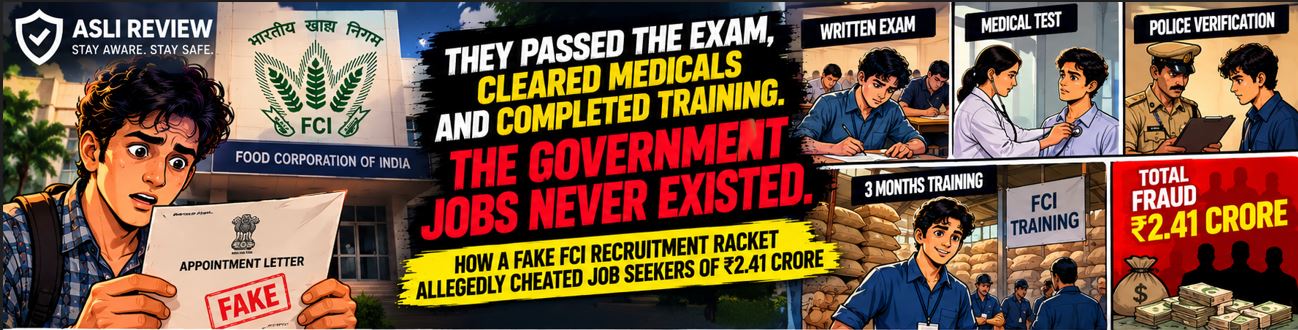
# They Passed the Exam, Cleared Medicals and Completed Training. The Government Jobs Never Existed.
A fake job advertisement is one thing. But what happens when the fraudsters organise written examinations, arrange medical tests, conduct police verification and even make candidates attend three months of training?
That is the disturbing pattern alleged in a government recruitment scam investigated by the Central Bureau of Investigation (CBI).
According to The Indian Express, at least 11 job seekers were allegedly cheated of a combined ₹2.41 crore after being promised jobs at the Food Corporation of India (FCI) and other government institutions. The alleged racket involved fake recruitment procedures and forged appointment letters.
The Indian Express
The question is no longer simply, "How do I recognise a fake job advertisement?"
It is this:
How do you recognise a fake recruitment process when almost every step looks genuine?
Fraud Snapshot
Source: The Indian Express, October 15, 2026.
The details are allegations reported in connection with the investigation. They should not be treated as established findings of guilt.
What Happened?
According to the CBI case described in the report, the alleged racket operated between August 2023 and 2025.
The candidates were reportedly promised government jobs, including positions at the Food Corporation of India.
The alleged fraudsters did not simply promise employment over the phone. They reportedly recreated several stages of a genuine recruitment process.
Candidates allegedly:
* Appeared for written examinations using OMR answer sheets. * Attended medical examinations. * Received calls for police verification. * Received forged appointment letters. * Attended a purported three-month training programme at an FCI godown in Sirsa district.
The accused allegedly demanded different amounts for different positions, including supervisor, clerical and peon posts.
The process appeared convincing enough that candidates reportedly paid substantial amounts in the hope of securing permanent government employment.
The case came to light after a candidate from Panipat complained that he had allegedly been cheated of ₹14 lakh. The CBI subsequently registered a case involving eight accused, according to the report.
The Indian Express
> The chilling lesson: a process can look official without being authorised by the government.
The Scam's Most Dangerous Feature: Manufactured Legitimacy
Most people are taught to watch out for obvious red flags:
* Poorly written advertisements. * Unknown WhatsApp numbers. * Requests for money before an interview. * Unrealistic salary promises. * Fake-looking websites.
But this case highlights a more sophisticated problem.
What if the scammers arrange an examination centre?
What if they provide OMR answer sheets?
What if you attend a medical examination and receive a formal-looking appointment letter?
Each additional step can make the opportunity feel more believable.
The victim may think, "If this were fake, why would they go to so much trouble?"
That assumption is precisely what makes this type of alleged fraud dangerous.
A convincing process is not the same as an authorised process.
How the Alleged Recruitment Scam Worked
The following is a simplified explanation based on the reported case, not a claim that every recruitment scam follows the same sequence.
Stage 1: The Government Job Promise
Candidates were allegedly told that government positions could be arranged through contacts and intermediaries.
For someone looking for stable employment, the offer could appear life-changing.
Stage 2: The Trust-Building Connection
The reported complaint described introductions through acquaintances and claims of influential connections.
Personal referrals can reduce suspicion because people tend to trust someone introduced by a friend, relative or familiar person.
But an introduction is not proof of recruitment authority.
Stage 3: The Examination
Candidates allegedly appeared for written examinations using OMR sheets at different locations in Haryana.
This created the impression that a formal selection process was underway.
Stage 4: Medical Tests and Police Verification
The candidates reportedly underwent medical examinations and received calls related to police verification.
These are familiar steps in many legitimate recruitment processes, making them powerful tools for creating a false sense of security.

Stage 5: The Appointment Letter
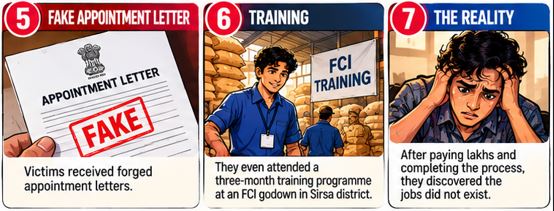
The alleged fraudsters reportedly issued forged appointment letters.
A document that looks official can influence a candidate's decision, especially after months of effort and substantial payments.
Stage 6: Three Months of Training
According to the report, candidates even attended a purported three-month training programme at an FCI godown in Sirsa district.
This was not merely a fake job promise made online. The alleged operation created an extended experience that resembled employment preparation.
Eventually, the candidates discovered that the promised jobs did not exist.
Why Victims May Not Recognise the Fraud Early
The alleged scheme exploited more than the desire for a government job. It potentially relied on several psychological factors.
* Hope: A government job can offer financial stability and long-term security. * Social proof: Other candidates going through the same process can make an opportunity appear legitimate. * Authority bias: Government names, formal documents and claims of influential connections can discourage questioning. * Sunk-cost thinking: After paying substantial sums and attending multiple stages, a candidate may feel compelled to continue. * Fear of losing the opportunity: The possibility of losing a job after coming so far can make further payments seem worthwhile.
None of these reactions means a candidate is foolish.
The responsibility lies with those who allegedly exploited the recruitment process and the candidates' hopes.
The AsliReview Rule: Verify the Vacancy, Not Just the Recruiter
This is the most important lesson from the case.
Do not verify only the person who contacted you. Verify the actual vacancy and the recruitment authority.
A recruiter might show you an identity card. An intermediary might provide an appointment letter. Someone might even take you to a location associated with the organisation.
None of those steps independently proves that the job is genuine.
Before paying any recruitment-related fee or committing to a process, verify the vacancy through the official recruitment channel of the organisation concerned.

For FCI recruitment, start with the official Food Corporation of India website and locate the relevant recruitment notification or official recruitment link.
Check whether the advertised position, eligibility criteria, selection stages and application instructions match the official notification.
If you cannot independently confirm the vacancy, do not proceed based solely on an intermediary's assurances.
Warning Signs of a Fake Government Job
Watch for these red flags.

* Guaranteed selection: Someone promises a government job regardless of your performance. * Influential connections: A recruiter claims that a powerful contact can bypass the official selection process. * Large payments: You are asked for lakhs of rupees to secure a post. * Unverified recruitment stages: Examination centres, medical tests or training arrangements cannot be confirmed through the official recruitment authority. * Unofficial appointment letters: You receive an offer that cannot be independently verified. * Changing payment demands: New amounts are requested for processing, joining, posting or other unexplained reasons. * Pressure to act quickly: You are told that the opportunity will disappear unless you pay immediately. * No verifiable official notification: The recruiter cannot direct you to an authentic vacancy announcement.
One red flag does not automatically prove fraud. But multiple red flags should prompt you to stop and verify before proceeding.
How to Verify a Government Job Offer
Use this checklist before making any commitment.
* Find the recruitment notification on the official organisation's website. * Confirm the exact post name, number of vacancies and eligibility requirements. * Check the application procedure and selection stages against the official notification. * Verify examination dates, centres and medical requirements through official recruitment communications. * Check whether the appointment letter can be confirmed through the organisation's authorised channel. * Do not rely on screenshots, forwarded PDFs or WhatsApp messages as your only evidence. * Be suspicious of intermediaries who promise guaranteed selection in exchange for money. * Do not share sensitive documents with unverified recruiters. * Preserve messages, receipts and documents if anything appears suspicious. * Contact the organisation through independently obtained official contact details if you have doubts.
Important: Some legitimate recruitment processes may involve prescribed fees or formal medical examinations. The presence of a fee or test alone does not prove fraud. Verify the specific requirement through the official notification and authorised channels.
What If Someone Has Already Paid?
If you suspect that you have been cheated in a recruitment scam, act promptly.

* Preserve all payment receipts, bank statements and transaction IDs. * Save the original advertisement, messages, phone numbers, appointment letters and other documents. * Contact your bank or payment provider if money was transferred electronically. * Report suspected financial cyber fraud by calling 1930. * Submit a complaint through the National Cyber Crime Reporting Portal if the incident involves cyber fraud. * Report the alleged recruitment fraud to the relevant police authorities. * Inform the genuine organisation if its name, logo or recruitment process appears to have been misused.
Do not pay another fee simply because someone promises to recover your money or arrange the job after all.
Common Mistakes Candidates Should Avoid
* Trusting an intermediary because they were introduced by someone familiar. * Assuming that an examination centre proves the recruitment is genuine. * Believing a formal-looking appointment letter without independent verification. * Treating a medical examination or training programme as conclusive proof of authenticity. * Paying large sums because the recruiter claims to have government contacts. * Continuing to pay because substantial money has already been spent. * Sharing identity documents and personal information before confirming the recruiter's legitimacy.
The most expensive mistake may be assuming that a recruitment process must be genuine simply because it looks complete.
Reality Check: Can Someone Guarantee a Government Job?
A claim of guaranteed selection through personal influence should be treated with extreme caution.
Legitimate recruitment follows the rules and procedures specified by the recruiting organisation. The precise process differs by post and institution, so candidates should always consult the official notification.
An intermediary's promise, personal connection or appointment letter does not replace independent verification.
If someone asks for lakhs in exchange for guaranteeing a government job, stop and verify before paying.
AsliReview Tip

> Never pay for a promise that you cannot independently verify.
A real examination, a medical test and a training programme can all be imitated. The decisive question is whether the recruiting organisation actually authorised the vacancy and the process you are being asked to follow.
The AsliReview 10-Point Government Job Safety Checklist
- I have found the vacancy on the official organisation's website.
- I have checked the recruitment notification and eligibility requirements.
- I have verified the selection process independently.
- I have not relied solely on a personal referral.
- I have checked the authenticity of the examination arrangements.
- I have verified medical tests and training requirements through official channels.
- I have independently confirmed the appointment letter.
- I have not paid an intermediary for a guarantee of selection.
- I have preserved receipts and communications.
- I know how to report suspected recruitment fraud.
If you cannot verify the vacancy or the recruiter's authority, do not make a payment until the doubts are resolved.
FAQs
How much money was allegedly involved in the FCI recruitment scam?
According to The Indian Express, the CBI case involved an alleged ₹2.41 crore collected from at least
Report it on AsliReview and help protect others from the same fraud.
🚨 Report a Fraud →