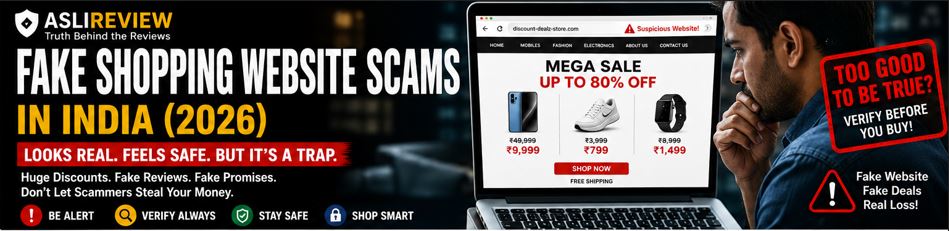
Part 10: Fake Shopping Website Scams in India (2026): How to Spot Fake Sites
By AsliReview Team · 28 August 2026
You see an advertisement on Instagram. A branded smartphone is listed for ₹19,999. The original price is supposedly ₹59,999. The website looks professional. There are hundreds of reviews.
The checkout page has a secure-looking payment screen, UPI, cards, net banking, and a cash-on-delivery option. Everything looks normal. You place the order. You receive an order confirmation. Then you wait.
Nothing arrives. You try to contact customer support. The phone number doesn't work. The email bounces. The website suddenly disappears. You search for the company again. And now you discover something uncomfortable: the entire store may have been created to collect money from people like you.
Welcome to the world of fake shopping websites.
These scams are becoming more convincing because fraudsters don't always create obviously suspicious websites. Some imitate the appearance of legitimate stores. Some copy brand photographs. Some use professional-looking logos. Some create fake reviews. Some even use advertisements to bring people directly to the fraudulent website.
The National Consumer Helpline warns consumers about suspiciously low prices, poor-quality site content, copied brand layouts/images and domains that imitate legitimate businesses. And India's National Cyber Crime Reporting Portal currently provides a Report Suspect facility specifically for suspicious website URLs and other identifiers.
Verify the website, seller, domain, payment method and return policy before paying
What Is a Fake Shopping Website?
A fake shopping website is a website designed to appear like a genuine online store but is operated for deceptive or fraudulent purposes. The site may take payment and never deliver, send a counterfeit product, send a completely different product, harvest card or personal information, redirect users to malicious pages, collect phone numbers and email addresses for further scams, or use fake customer support to demand additional payments.
The website might pretend to be a major electronics store, a fashion brand, a furniture company, a cosmetics retailer, a footwear brand, a jewellery store, a grocery website, a mobile-phone store, a local business, or a discount outlet. Sometimes the scammer doesn't even copy an entire company — they simply create a completely new store with a believable name.
Why Do Fake Shopping Websites Work?
Because people naturally look for three things when shopping: price, trust, and convenience. Scammers manipulate all three — "70% OFF — TODAY ONLY!" for price, "4.9/5 from 12,000 customers" for trust, and "Order now — delivery in 2 days" for convenience.
The website creates the feeling that you're getting a great deal from a legitimate business. The problem is that the entire presentation can be manufactured.
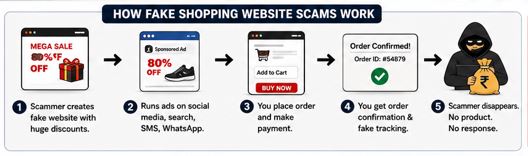
How Does a Fake Shopping Website Scam Work?
AsliReview_FakeShoppingWebsite_HowitWorks
Step 1: The Scam Website Is Created
The fraudster creates a domain name, logo, product catalogue, product descriptions, contact page, fake reviews, and payment page. The site may look surprisingly professional.
Step 2: Products Are Given Huge Discounts
For example, ₹49,999 → ₹14,999, or ₹9,999 → ₹2,499. The objective is to make the deal difficult to ignore.
Step 3: Traffic Is Generated
Potential victims may arrive through search engines, social-media advertisements, Instagram, Facebook, WhatsApp, SMS, email, or influencer-style promotions. The National Cyber Crime Reporting Portal has warned about various online fraud methods involving deceptive websites and links, while its cyber-safety guidance advises users to be cautious about shopping through unfamiliar links and websites.
Step 4: The Victim Places an Order
The site may provide an order confirmation, order number, email, SMS, and tracking page. This creates confidence.
Step 5: The Scam Happens
Several outcomes are possible: you pay and nothing is delivered, a counterfeit product arrives, a completely different product arrives, the website asks for another payment, or the website was designed to collect payment or personal information all along.
What Happened? An Illustrative Example
Rohit wants to buy a branded pair of headphones. He sees an advertisement: ₹12,999 → ₹2,999. The advertisement takes him to a professional-looking website with a brand logo, product photographs, customer reviews, "Secure Payment," "7-Day Return," and "Free Shipping."
Rohit pays ₹2,999 through UPI and receives an order confirmation. Three days later, the tracking page still says "Order Processing." He emails customer support — no response. He calls the number — it doesn't work. A week later, the website stops loading.
What went wrong? Rohit didn't necessarily ignore every warning. The scam worked because the website created multiple false signals of legitimacy. That's what makes modern fake shopping websites dangerous.
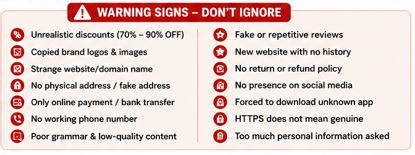
AsliReview_FakeShoppingWebsite_WarningSigns
🚩 Warning Sign #1: The Price Is Unrealistically Low
This is probably the most obvious warning sign, but it is also one of the most effective. Imagine a product normally selling for ₹40,000 offered on a new website for ₹11,999. There could be a legitimate explanation — clearance stock, a refurbished unit, an old model, or a genuine sale. But before paying, ask why this website is selling it for so much less.
The National Consumer Helpline specifically advises consumers to compare prices and exercise caution when a price is significantly different from similar products elsewhere. Compare the product on the manufacturer's website, established retailers, major marketplaces, and other reputable sellers.
🚩 Warning Sign #2: The Website Copies a Famous Brand
Suppose a genuine brand's website is brandname.com. A scammer may register something like brandname-sale.com or official-brandstore.in — a domain designed to look associated with the brand. The site may copy the logo, colours, product photographs, descriptions, layout, and terms and conditions.
The National Consumer Helpline specifically warns that counterfeit websites can imitate brand-owner layouts, use similar images and use official-sounding domain names.
💡 AsliReview Tip
The logo is not proof that you're on the official website. The domain matters.
🚩 Warning Sign #3: The Domain Name Looks Strange
Look carefully at the website address. Watch for extra words, strange hyphens, misspellings, unusual combinations, domains designed to imitate the brand, and unexpected country/domain extensions. If the real brand is example.com, a suspicious website could be example-india-sale.com. That doesn't automatically mean it's fraudulent, but it deserves verification.
Important: HTTPS Does NOT Mean "Genuine"
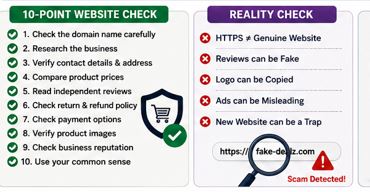
This is one of the biggest misconceptions about website safety. You may see 🔒 HTTPS and assume "this website is safe." Not necessarily — HTTPS primarily helps protect the connection between your browser and the website. A fraudulent website can also use HTTPS.
HTTPS can help secure a connection. It does not prove that the business behind the website is genuine.
🚩 Warning Sign #4: The Website Has No Real Company Information
Look at the About Us, Contact, Company Information, Address, Terms, Refund Policy, and Privacy Policy pages. A fake store may have generic text copied from elsewhere, or provide no physical address, only a Gmail address, a non-working phone number, or no legal business information.
For an unfamiliar store, research the business independently before paying. The National Consumer Helpline recommends researching unfamiliar sellers and checking their business history and contact information.
🚩 Warning Sign #5: The Contact Number Doesn't Work
Try the phone number before buying. Does it connect, identify the business, provide useful support, and match the company information? If the only support channel is a WhatsApp number and nobody answers normal calls, be cautious.
🚩 Warning Sign #6: The Email Address Looks Unprofessional
Imagine the website claims to be "XYZ Electronics Pvt. Ltd." but the support email is xyzshoppinghelp@gmail.com. That's not automatic proof of fraud — small businesses legitimately use free email providers. But for a large established brand, an unrelated email address deserves verification.
🚩 Warning Sign #7: Fake or Repetitive Reviews
A fake shopping website may display ⭐⭐⭐⭐⭐ "Amazing product!" "Best website!" "Fast delivery!" "Very genuine!" — but every review sounds almost identical. That's suspicious.
Don't only count stars. Look for specific product experiences, different writing styles, different dates, verified-purchase indicators where applicable, negative reviews, detailed complaints, and responses from the seller. A website showing only perfect reviews deserves extra scrutiny.
🚩 Warning Sign #8: The Website Has Just Been Created
A new website isn't automatically fraudulent — every legitimate business was new at some point. But if the website claims "Serving India for 15 years" while the domain appears to have been created very recently, that's worth investigating.
💡 AsliReview Tip
Claimed business age and actual digital history should make sense together.
🚩 Warning Sign #9: The Website Uses Copied Product Images
A scammer can download product photographs from brand websites, Amazon, Flipkart, Instagram, manufacturer catalogues, and other online stores. Don't assume "they have professional photographs, therefore they must be genuine." Use reverse-image search when something feels suspicious — if the exact same image appears across many unrelated stores, investigate further.
🚩 Warning Sign #10: Everything Is "70%–90% OFF"
One huge sale isn't proof of fraud, but when every product is dramatically discounted — ₹49,999 → ₹4,999, ₹19,999 → ₹1,999, ₹9,999 → ₹999 — that's not necessarily a sale. It may be bait.
🚩 Warning Sign #11: Cash on Delivery Suddenly Disappears
A website advertises "Cash on Delivery Available." You reach checkout, and suddenly: "COD unavailable for your location." You are pushed toward UPI/Card/Bank Transfer. This alone doesn't prove fraud, but combined with other warning signs, be cautious.
🚩 Warning Sign #12: The Website Keeps Redirecting You
You click one product, you end up somewhere else. You click checkout, another page opens. You receive multiple redirects. Stop. I4C's cyber-safety guidance warns users to be cautious when clicking unfamiliar links and recommends safer browsing practices.
🚩 Warning Sign #13: You Are Asked to Download an APK
This is a major warning sign. A shopping website may say "Install our Android app for an additional discount" and provide an APK directly. Don't install it casually — I4C advises users to install applications only from trusted sources.
🚩 Warning Sign #14: Payment Is Requested Outside the Website
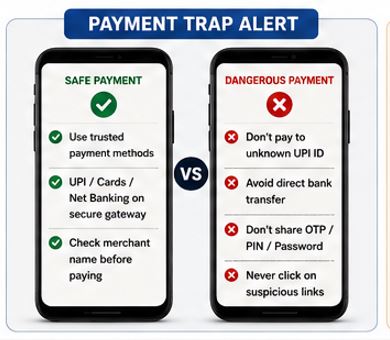
You are told "Our payment gateway is down. Send money to this UPI ID," or "Pay directly to our account for an extra 20% discount." This removes whatever protection the platform may otherwise provide. Use the website's established payment process where appropriate — if a seller suddenly changes the payment method, stop and verify.
🚩 Warning Sign #15: The Website Wants Too Much Personal Information
Be cautious if a shopping website asks for excessive identity details, banking credentials, UPI PIN, OTP, ATM PIN, or passwords.
💡 AsliReview Rule
A shopping website does not need your UPI PIN. Never share your UPI PIN with anyone.
Fake Shopping Website vs. Genuine New Business
This distinction matters — we don't want to label every small or unfamiliar online store a scam. A genuine new business can have a new domain, few reviews, small social-media presence, limited product range, and basic website design. None of these alone prove fraud.
The real question is: can the business be independently verified? Look for consistency between company identity, website, contact details, address, social profiles, product information, payment details, and customer feedback. The more pieces that independently line up, the stronger the trust signal.
The AsliReview 10-Point Website Check
AsliReview_FakeShoppingWebsite_10PointsCheck
Before buying from an unfamiliar online store, check these ten things:
Website address — is the domain exactly what you expect?
Company identity — who operates the store?
Contact details — is there a genuine way to contact them?
Address — can the business location be independently verified?
Product pricing — does the price make sense?
Reviews — are reviews detailed and believable?
Return policy — is it clear and realistic?
Payment — are you being pushed toward unusual payment methods?
Product images — do the images appear original?
Independent reputation — what do people outside the website say about the business?
If several answers don't make sense, don't pay yet.
How to Check If a Shopping Website Is Genuine
Step 1: Don't Start With the Advertisement
If you see an Instagram or Facebook advertisement, don't assume the destination is trustworthy simply because the advertisement appears on a major platform. Open a new browser tab and search for the business independently.
Step 2: Check the Official Brand Website
If the website claims to sell a famous brand, visit the brand's official website yourself. Ask: does this store appear to be an authorized seller? If the brand doesn't mention it anywhere, investigate further.
Step 3: Search the Company Name + "Scam"
For example, "XYZ Store scam" or "XYZ Store reviews." Don't rely on a single result — look for patterns.
Step 4: Search the Domain Name
Search the exact domain. Look for consumer complaints, scam reports, reviews, business information, and older references.
Step 5: Compare Product Images
Check whether the images appear elsewhere. Copied photographs don't prove fraud, but they can be a useful warning sign.
Step 6: Check the Payment Page
Before entering payment information, verify the merchant name, amount, website domain, and payment destination. If the payment suddenly redirects to an unrelated account or domain, stop.
Step 7: Save Evidence
Before paying, save the product page, price, terms, return policy, and seller information. This can become valuable if something goes wrong.
The "Too Good to Be True" Test
Let's say you find a ₹79,999 TV for ₹29,999. Don't immediately think "What a deal!" Ask "Why is it so cheap?" Maybe it's an old model, refurbished, clearance stock, damaged, counterfeit, a fake listing, or a genuine promotion. The price alone doesn't tell you which one — verification does.
Fake Shopping Website Scam Through Social Media
This deserves special attention. A scammer runs an advertisement — "Closing Sale! Everything 80% OFF!" You click, the website looks professional, you order, and the advertisement disappears. You try to find the company again — nothing.
Warning signs: huge discount, countdown timer, "Only 3 left!", "Last few hours!", new social-media account, comments disabled, comments full of generic praise, and little independent reputation.
Fake Instagram Store Scam
Not every Instagram store is fraudulent, but social media makes it easy to create a convincing storefront quickly. A scam page can have thousands of followers, beautiful photographs, reels, influencer-style posts, and fake testimonials. Followers are not proof of legitimacy — check account history, comments, tagged customers, independent reviews, business details, payment method, and return policy.
Fake WhatsApp Shopping Scam
You receive "Special Diwali Clearance — 80% OFF" with a link. You click, and the website asks for payment. This type of message can be forwarded thousands of times. Don't assume that a message came from a friend or family member therefore the website is safe — verify it independently.
Fake Brand Website Scam
A scammer may imitate a famous brand so closely the site looks almost identical. Look at the URL carefully — spelling, domain, country extension, extra words, hyphens, subdomains. A website can look perfect while the address tells you something is wrong.
Suppose the genuine brand is brand.com. These are not automatically legitimate: brand-sale.com, brandindiaoffers.com, officialbrandstore.in, brand-discount.shop. The important point: don't judge the website by the logo — judge the business and domain by independent verification.
Does a Padlock Mean the Website Is Safe?
No. The padlock generally indicates an encrypted connection. It does not tell you who owns the website, whether the seller is honest, whether the product exists, or whether you'll receive your order.
HTTPS ≠ genuine business.
What If the Website Has a "Secure Payment" Logo?
AsliReview_FakeShoppingWebsite_PaymentTrapAlert
Don't blindly trust badges. Scammers can place images of secure payment, SSL, Visa, Mastercard, trusted seller, or verified business badges on a webpage. A logo is not proof — check the actual payment process and the business behind the website.
What If the Website Has a GST Number?
A GST number can be a useful business detail, but its presence on a website should not by itself prove that the website is genuine. Verify business information independently where possible. The same principle applies to company registration numbers, addresses, certificates, and licences — a displayed number is not the same as independent verification.
❌ Common Mistakes People Make
Buying because of a huge discount — the discount is often the bait
Trusting the website design — a professional website can be built quickly
Trusting the logo — a logo can be copied
Trusting five-star reviews — reviews can be manipulated
Assuming HTTPS means safe — HTTPS doesn't prove legitimacy
Paying by direct bank transfer — this can reduce your options if the seller turns out to be fraudulent
Ignoring the return policy — some fake stores use copied or meaningless policies
Not saving evidence — once a fake website disappears, you may regret not taking screenshots
🧾 Before You Pay: The AsliReview 60-Second Check
Before paying an unfamiliar shopping website, spend one minute checking:
URL — does the domain make sense?
Price — is the discount realistic?
Business — who actually runs this store?
Reviews — what are people saying outside the website?
Contact — can you actually reach the business?
Return — is the return policy clear?
Payment — are you being pushed into an unusual payment method?
Product — are the images copied?
Reputation — does the business have an independent history?
Feeling — does something feel wrong?
If several checks fail, walk away.
What If You Already Ordered?
Don't panic. First determine what happened.
You paid but the order hasn't arrived — save the order confirmation, payment receipt, website screenshots, email, phone number, and tracking details. Contact the seller through the available official channel.
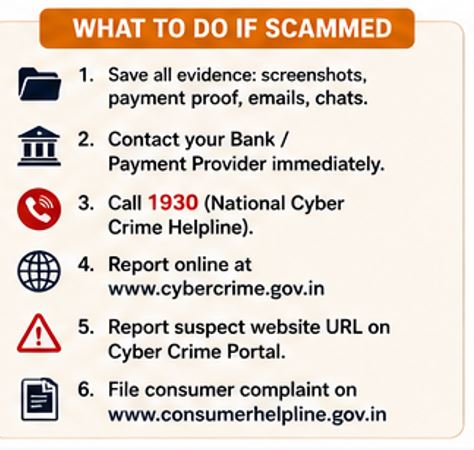
The website has disappeared — don't keep trying to negotiate with the scammer. Preserve evidence. Contact your bank/payment provider if money was transferred fraudulently.
You received the wrong product — take photographs. Keep the packaging, invoice, shipping label, product, unboxing evidence, and communication. Contact the platform/seller. If unresolved, consider the National Consumer Helpline.
You received a counterfeit product — document everything. Don't throw away packaging, invoice, product labels, serial numbers, or shipping materials — a consumer complaint may require evidence.
You shared card or banking information — contact your bank immediately, monitor the account, and take appropriate steps to secure your account and payment credentials.
If Money Has Been Lost Through Fraud
Act immediately.
Step 1: Contact Your Bank
Tell the bank about the fraudulent transaction.
Step 2: Call 1930
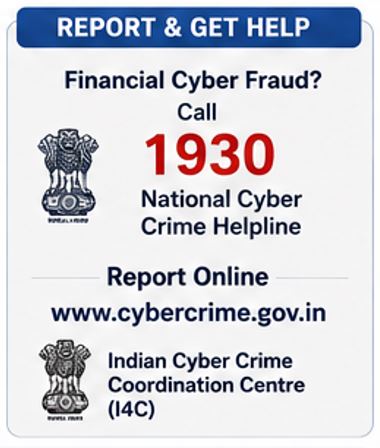
India's National Cyber Crime Reporting Portal states that financial cyber fraud should be reported immediately through 1930, available 24×7.
Step 3: Report Online
Use the National Cyber Crime Reporting Portal. The portal currently provides dedicated financial-fraud reporting and a facility to report suspicious website URLs and other identifiers.
Step 4: Preserve Evidence
The portal's complaint checklist asks victims of financial fraud to keep information such as the bank/wallet/merchant name, transaction/UTR number, date, fraud amount and relevant evidence ready.
What If You Only Found a Suspicious Website?
You don't necessarily need to wait until someone loses money. I4C's National Cyber Crime Reporting Portal has a Report Suspect facility for suspicious website URLs, phone numbers, WhatsApp/Telegram handles, email IDs, SMS identifiers and social-media URLs. This can be useful when you encounter a suspicious shopping website that appears fraudulent.
National Consumer Helpline vs. Cybercrime Portal
This distinction is important.
Use the cybercrime route (1930 / National Cyber Crime Reporting Portal) when you believe you've experienced financial cyber fraud, an unauthorized payment, a fake website payment scam, online financial deception, or a fraudulent payment request.
Consider the National Consumer Helpline when your issue is primarily a consumer grievance such as a wrong product, defective product, non-delivery, refund dispute, or service deficiency. The National Consumer Helpline provides consumer grievance channels and publishes cases involving e-commerce complaints.
The correct route depends on what actually happened — a consumer dispute and a deliberate cyber fraud are not necessarily the same thing.
💡 AsliReview Tip — Don't Wait Until the Website Looks Suspicious
The best time to investigate a shopping website is before payment, not after. Before you click Pay, take one minute to verify the store. That minute can save hours — or much more.
📌 Reality Check
Myth: If Google shows the website, it must be genuine.
Reality: Search engines can surface websites that aren't trustworthy. I4C's own cyber-safety material advises users to use familiar shopping websites rather than blindly shopping through search results, because search results can lead users to malicious websites.
📌 Reality Check
Myth: HTTPS means the website is genuine.
Reality: HTTPS helps protect the connection. It doesn't prove that the business behind the website is legitimate.
📌 Reality Check
Myth: A website with thousands of followers must be genuine.
Reality: Social-media followers can be misleading. Look for independent evidence of the business.
📌 Reality Check
Myth: A very cheap product is simply a great deal.
Reality: It might be. But it could also be counterfeit, defective, non-existent or part of a fraudulent offer. Compare prices and research the seller before paying.
📌 Reality Check
Myth: If the website has a professional design, it's safe.
Reality: Website design can be copied. A scammer can create a professional-looking storefront. Trust should come from independent verification, not appearance.
The AsliReview Website Trust Score
You can manually score an unfamiliar store using this thinking tool:
Clear business identity
+1
Verifiable contact details
+1
Established independent reputation
+1
Realistic pricing
+1
Clear return policy
+1
Consistent business information
+1
Protected payment options
+1
Genuine product information
+1
Suspicious domain
-2
Extreme discount
-2
No independent reviews
-1
Only prepaid/direct transfer
-2
Fake-looking contact details
-2
This is not a scientific fraud-detection system — it's simply a thinking tool. A high score doesn't guarantee safety. A low score tells you to investigate more, or walk away.
🛡 Quick Fake Website Safety Checklist
Before buying:
Did I check the exact website address?
Is the business independently verifiable?
Is the price realistic?
Did I research the seller?
Did I check independent reviews?
Is the return policy clear?
Does the contact information work?
Do product images appear genuine?
Am I being pushed to pay directly?
Am I being asked for unnecessary personal information?
Did I arrive through an advertisement or unknown link?
Have I checked whether the website has complaints?
Have I saved the product and payment details?
If several answers are No, don't pay yet.
The 30-Second "Walk Away" Rule
You don't need to prove that a website is a scam before deciding not to buy from it. If you can't verify who runs it, where they are, how to contact them, why the price is so low, and what happens if the product doesn't arrive — you don't need to take the risk. You can simply walk away. There will always be another deal. There may not be another chance to recover your money easily.
Frequently Asked Questions
How can I check if an online shopping website is genuine?
Start with the exact domain name, then independently verify the business, contact information, seller history, pricing, return policy and external reputation. Don't judge the website solely by its appearance.
Is HTTPS enough to trust a shopping website?
No. HTTPS helps secure communication between your browser and the website, but it doesn't prove that the business operating the website is genuine.
Can a fake shopping website look exactly like a real brand website?
Yes. Fraudulent websites can imitate legitimate brands using copied logos, images, layouts and similar-looking domain names. The National Consumer Helpline specifically warns consumers about this practice.
Are huge discounts always a scam?
No. Legitimate businesses can offer large discounts. But an unusually large discount should make you research the seller and compare prices before paying.
Can I trust a shopping website because it has customer reviews?
Not automatically. Look beyond the number of reviews — check whether they appear genuine, detailed and independent.
Can scammers create fake order-confirmation emails?
Yes. An email saying "Order Confirmed" does not prove that a legitimate company received your payment. Check the order through the official website or app.
What if a fake website sends me a tracking number?
A tracking number doesn't necessarily prove that a genuine order exists. Verify it through the actual courier's official tracking system where possible.
What if I paid a fake shopping website through UPI?
Contact your bank/payment provider immediately. For financial cyber fraud, report it through 1930 and the National Cyber Crime Reporting Portal as soon as possible.
What if I paid by card?
Contact your card-issuing bank immediately and explain that you believe the transaction is fraudulent. Ask what dispute/security steps are available for your transaction.
What if I only entered my phone number and email address?
Be alert for follow-up scams — you may receive fake delivery calls, fake refund messages, fake customer-care calls, or phishing links. Don't assume a later caller is genuine simply because they know that you placed an order.
Can I report a fake shopping website if I haven't lost money?
Yes. I4C's National Cyber Crime Reporting Portal provides a Report Suspect facility for suspicious website URLs and other cybercrime identifiers.
What information should I keep before filing a cybercrime complaint?
The National Cyber Crime Reporting Portal's checklist asks financial-fraud victims to keep details such as the bank/wallet/merchant name, transaction or UTR number, transaction date, fraud amount and supporting evidence.
Where should I report online shopping fraud in India?
For financial cyber fraud, use 1930 and the National Cyber Crime Reporting Portal. For consumer grievances such as non-delivery, defective products or unresolved refund disputes, the National Consumer Helpline may also be relevant.
Related AsliReview Guides
This article connects closely with AsliReview's guides on online marketplace scams (fake sellers and counterfeit products), fake customer care scams (fake support numbers), fake refund scams (post-purchase payment traps), QR code scams, and UPI fraud — together forming a growing digital-payment fraud cluster.
Final Word
AsliReview_FakeShoppingWebsite_WhatToDoIfScammed
A fake shopping website doesn't always look fake. That's the biggest lesson. It may have a beautiful design, a familiar logo, hundreds of reviews, huge discounts, a professional checkout, an order confirmation, and a tracking page. Everything can look right. And yet the business behind the website may not be what it claims to be.
So don't ask only "Does this website look genuine?" Ask "Can I independently verify that this business is genuine?" That's a much stronger question.
Before buying from an unfamiliar website: check the domain, research the business, compare the price, look for independent reviews, check the return policy, verify the payment destination, and save your evidence. And if something doesn't add up, walk away — you don't need to prove a website is fraudulent before deciding that it isn't worth the risk.
If you've already lost money, don't waste time arguing with the website. Contact your bank or payment provider. Call 1930. Report the incident through the National Cyber Crime Reporting Portal. Preserve your evidence.
AsliReview_FakeShoppingWebsite_1930
The safest online shopper isn't the one who finds the biggest discount. It's the one who knows when to stop before pressing Pay.
AsliReview_FakeShoppingWebsite_Footer
Been cheated by a vendor?
Report it on AsliReview and help protect others from the same fraud.