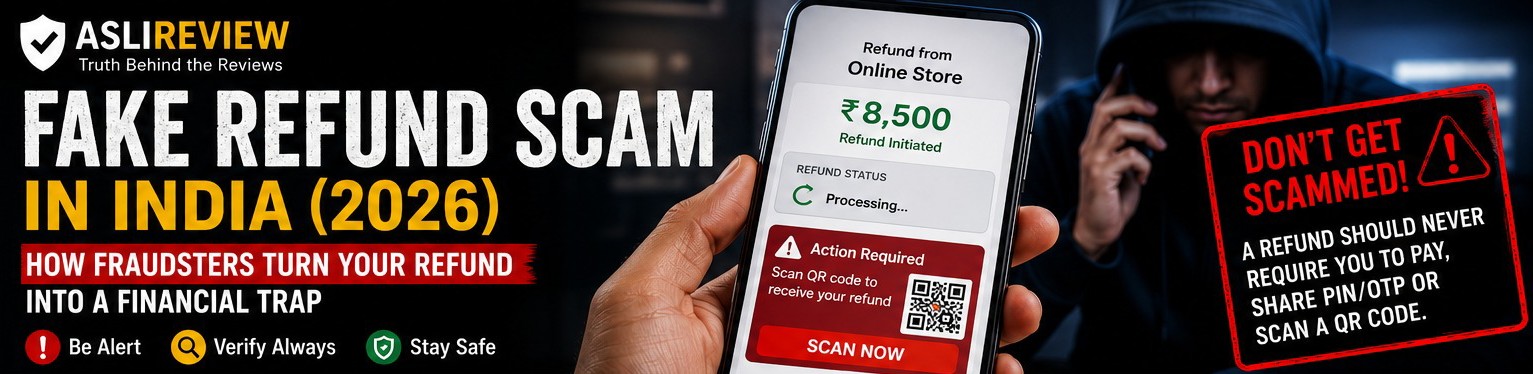
Part 8: Fake Refund Scams: When Getting Your Money Back Becomes the Scam
By AsliReview Team · 21 August 2026
Imagine this. You ordered something online. The payment went through. The order failed. You are waiting for your refund.
Then your phone rings. "Sir/Madam, I'm calling from customer support. Your refund is stuck."
The caller already knows your name, your order number, the amount you paid, and the company you purchased from. So you naturally assume the caller is genuine.
Then comes the instruction: "I'll process the refund. Just scan this QR code." Or: "Please approve this UPI request." Or: "Enter your UPI PIN to receive the refund." Or: "Install this application so I can process the refund."
That's when the refund stops being a refund. It becomes a financial trap.
NPCI warns users about fake cashback links, QR-code scams, unknown applications and social-engineering tactics used to manipulate digital-payment users. It specifically notes that scanning a QR code and entering a UPI PIN is for making a payment, not receiving money.
RBI similarly warns consumers not to scan QR codes or click unknown links and states that entering a PIN or OTP is not required to receive money.
🚨 Fraud Snapshot
Category
Financial & Impersonation Fraud
Risk Level
🔴 Very High
Common Targets
Online shoppers, UPI users, bank customers
Common Channels
Phone calls, WhatsApp, SMS, email, fake websites
Common Tactics
Fake support, QR codes, UPI requests, refund links, OTP/PIN manipulation
Difficulty to Identify
Medium to High
Potential Loss
From a small amount to substantial financial loss
Best Protection
Verify the refund directly through the merchant or payment provider
What Is a Fake Refund Scam?
A fake refund scam happens when a fraudster pretends to be processing a refund and convinces the victim to perform an action that actually sends money, reveals sensitive information or gives the scammer access to the victim's device.
The scammer may pretend to represent an online shopping website, a bank, a UPI/payment service, a courier company, an airline, a hotel, a telecom company, a food-delivery service, a marketplace, or a government department. The story can be different — the objective is usually the same: make you trust the refund story enough to follow the scammer's instructions.
Why Refund Scams Are So Effective
There's a psychological trick behind this scam. You are not being offered something unbelievable. You're being promised money you already believe you're entitled to receive. That makes the request feel legitimate.
For example: "Your ₹8,500 refund is pending." You think: "Yes, I actually am waiting for ₹8,500." The scammer has already passed the first trust test. Now they only need to convince you that their process is genuine.
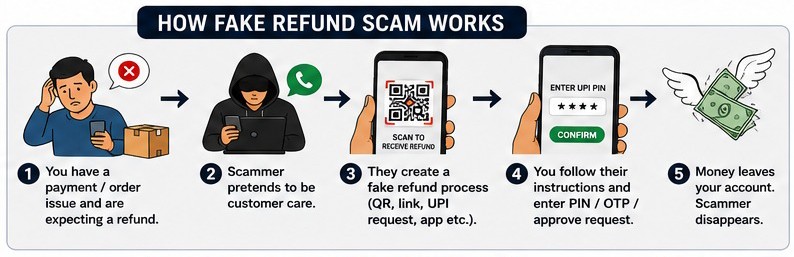
How Does a Fake Refund Scam Work?
Aslireview_HowFakeRefundScamWorks
Step 1: You Have a Genuine Refund Problem
Perhaps your order was cancelled, your payment failed, you returned a product, your flight was cancelled, your hotel booking was cancelled, or a wallet transaction failed.
Step 2: The Scammer Contacts You
They may call or message you claiming to be customer support. Sometimes, you may have contacted what you thought was customer care first. That's why fake customer-care scams and refund scams are closely connected.
Step 3: They Confirm Details
The scammer may already know some information about you. They might say "Your order number is 458921, correct?" You think "They know my order number. They must be genuine." Not necessarily — knowing one or two details is not proof of identity.
Step 4: They Create a Refund Process
This is where the scam begins. You may be told to click a link, scan a QR code, approve a UPI request, enter your UPI PIN, share an OTP, install an app, share your screen, or transfer a "verification amount."
Step 5: Money Leaves Your Account
Instead of receiving money, you authorize a transaction. The scammer gets paid. You get nothing.
What Happened? A Real 2026 Fraud Case Worth Knowing
In August 2026, a consumer dispute in Kerala involved a fake UPI cashback scheme in which a customer lost about ₹9,854 through unauthorized UPI transactions. The Thiruvananthapuram District Consumer Commission later ordered Federal Bank to refund the amount and also awarded compensation and litigation costs.
The case is a useful reminder that fraud disputes can become complicated after the money has already been debited. It also reinforces an important lesson: don't assume that a digital-payment fraud is simply a "small online mistake." Report it quickly and preserve evidence.
The Most Common Fake Refund Scams
1. Fake Customer Care Refund Scam
This is one of the most common patterns. You have a problem with an order, you find a customer-care number, someone answers, and they say "We can process your refund immediately." Then they send a QR code, payment request or link.
⚠️ Warning Signs
Caller contacted you unexpectedly
Refund requires you to send money
You are asked for your UPI PIN
You are asked to install an application
Caller wants you to stay on the phone
You are pressured to act immediately
What to Do Instead
Open the merchant's official app or website yourself. Check the refund status there. If necessary, contact the merchant using the official support channel.
2. QR Code Refund Scam
This is especially dangerous because it sounds logical. The scammer says "Scan this QR code to receive your refund." You scan it. The payment screen opens. You are asked to enter your UPI PIN.
Stop. A UPI PIN authorizes a transaction. NPCI states that the UPI PIN should not be shared and that entering it is part of authorizing a bank transaction. RBI also explicitly warns that receiving money does not require scanning a QR code or entering a PIN/OTP.
💡 AsliReview Rule
Never enter your UPI PIN just because someone says it is required to receive a refund.
3. Fake UPI Refund Request
The scammer says "I've initiated your refund. You just need to approve the request." You open your UPI app, a payment request appears, you approve it, and money leaves your account.
📌 Reality Check
A payment request is not the same thing as a refund credit. Always read what your UPI application is asking you to authorize.
4. Refund Processing Fee Scam
The scammer says "Your refund is ready. We just need ₹499 as a processing fee." You pay. Then: "There is a verification issue. Pay ₹999 more." And then another fee appears. This can become a fee escalation scam.
🚩 Warning Signs
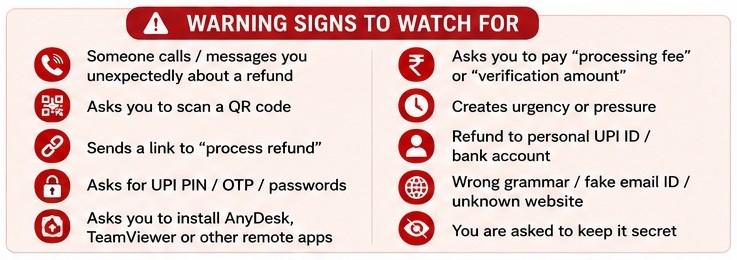
Aslireview_WarningSigns
Unexpected processing fee
New charges keep appearing
Payment is requested to a personal UPI ID
No official invoice or refund documentation
Caller becomes aggressive when you question the charge
5. Fake Refund Link
You receive an SMS or WhatsApp message: "Your refund of ₹7,450 is ready. Click here to claim." The link takes you to a website designed to look like the merchant. You are asked for card details, CVV, OTP, UPI information, or your password. The information can then be misused.
RBI has repeatedly warned consumers about suspicious links and sharing sensitive authentication information.
What to Do Instead
Don't click the link. Open the company's official app or website directly.
6. Fake Refund Through Remote Access
This one can be particularly dangerous. The scammer says "I'll connect to your device and process the refund for you." You are asked to install a remote-access application. The person then attempts to view or control your device.
RBI has warned about fraud involving spurious apps that can access sensitive information stored on devices.
❌ Never Do This
Don't give an unknown person remote access to your phone simply because they claim to be customer support.
7. Fake Bank Refund Scam
A caller claims "Your bank has received a refund from the merchant." They then ask for your OTP, card details, UPI PIN, account information, or screen sharing.
What to Do Instead
Contact the bank through the official number listed on its website, app, card or official documents. Don't use a number provided by the caller.
8. Fake Courier Refund
You receive a call: "Your parcel could not be delivered. We need your bank details to issue the refund." The scammer may then attempt to collect sensitive information. Never assume a caller is legitimate simply because they know the courier company or parcel details.
⚠️ Warning Signs to Watch For
Someone says you must pay to receive your refund — this deserves immediate scrutiny. Ask: why am I sending money to receive money?
Someone asks for your UPI PIN — stop. NPCI says your UPI PIN should not be shared with anyone.
Someone sends a QR code — don't assume it's a refund code. Read the payment screen carefully.
Someone sends a suspicious link — don't click it. Go directly to the official website or app instead.
Someone asks for an OTP — understand what the OTP is authorizing. Don't disclose it simply because the person says they are customer support.
Someone is creating urgency — statements like "your refund expires today," "do it in the next five minutes," "your money will be lost," or "the transaction will be cancelled" are classic pressure tactics.
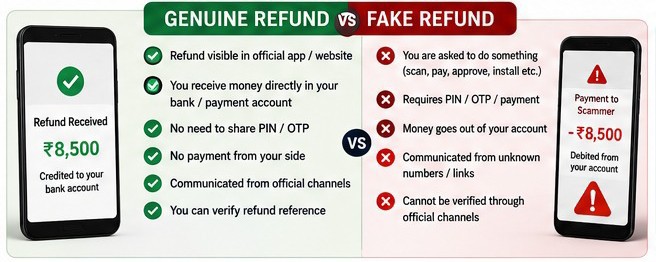
What a Genuine Refund Usually Looks Like
Aslireview_GenuineVsFakeRefund
There isn't one universal refund process. It depends on the merchant, payment method, bank, card network, UPI transaction, marketplace, or payment gateway.
But one principle is extremely useful: you should be able to verify the refund through the merchant or payment provider's official systems.
Open the official app, find your order, check the order/refund status, check your bank/payment account, and contact official support if the status is unclear. Don't let an unknown caller become your only source of truth.
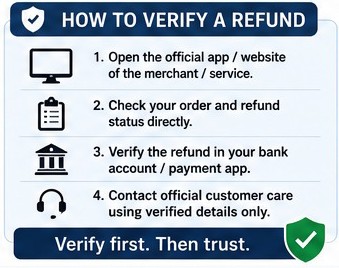
How to Verify a Refund
Aslireview_VerifyRefund
Step 1: Check the Original Order
Open the official merchant app or website. Look for Orders → Order Details → Refund Status.
Step 2: Check Your Actual Account
Don't rely on screenshots, WhatsApp messages, SMS sent by strangers, or caller statements. Check the actual account or transaction history.
Step 3: Verify the Refund Reference
If the merchant provides a refund reference or transaction identifier, use the merchant's official support channel to verify it.
Step 4: Contact Your Bank if Necessary
If the merchant says the refund has been processed but you don't see it, contact your bank using its official support channel.
The AsliReview Refund Verification Rule
Before trusting anyone who says "I am calling about your refund," ask yourself:
Did I initiate the refund?
Can I see the refund in the official app?
Can I verify this person independently?
Am I being asked to send money?
Am I being asked for a PIN or OTP?
Am I being asked to scan a QR code?
Am I being asked to install an app?
If the last four answers raise concern, stop.
❌ Common Mistakes
Trusting caller ID — a name appearing on your phone does not prove identity
Believing screenshots — a screenshot saying "Refund processed" doesn't prove that money has reached your account
Thinking a small payment is safe — scammers may start with "just pay ₹10 for verification," then the amount can increase
Sharing OTPs — an OTP can authorize an action; always understand what you're authorizing
Entering UPI PIN automatically — the PIN is an authorization step; don't enter it simply because someone tells you to
Searching for support in a panic — when people are frustrated, they often search for customer care and immediately call the first number they see; that is exactly when verification matters most
💡 AsliReview Tip — Your Refund Should Never Need Your Panic
If someone says "You have only two minutes to claim your refund," stop. A genuine customer-support process should be independently verifiable. Take a breath, close the call, open the official app, and check the refund status yourself.
📌 Reality Check
Myth: If someone knows my order number, they're definitely from the company.
Reality: Order numbers and other basic details do not prove someone's identity. Always verify the person through an independent official channel.
📌 Reality Check
Myth: I need to enter my UPI PIN to receive a refund.
Reality: For UPI, the PIN is used to authorize transactions. NPCI explicitly says not to share your UPI PIN, and RBI says entering a PIN/OTP is not required to receive money.
📌 Reality Check
Myth: A refund screenshot means the money has been returned.
Reality: Screenshots are not reliable proof. Check your actual account or official transaction history.
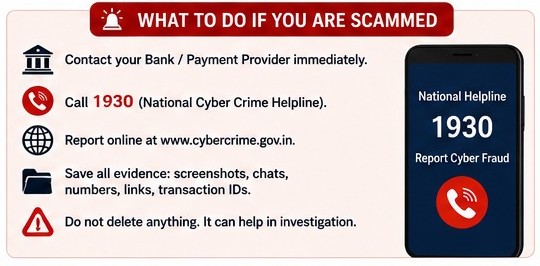
What If You Already Fell for a Refund Scam?
Aslireview_WhatToDoifScammed
Don't waste time blaming yourself.
Step 1: Contact Your Bank Immediately
Tell your bank about the fraudulent transaction. NPCI says complaints involving fraudulent, unidentified or unauthorized transactions should be raised with the respective bank for redressal.
Step 2: Call 1930
India's National Cyber Crime Reporting Portal identifies 1930 as the national helpline for reporting online financial fraud.
Step 3: Report Online
Report the incident through the National Cyber Crime Reporting Portal. The portal also allows citizens to report suspicious phone numbers, WhatsApp/Telegram handles, URLs, email IDs and social-media URLs.
Step 4: Preserve Everything
Keep phone numbers, WhatsApp chats, SMS messages, emails, screenshots, QR codes, payment links, UPI IDs, transaction IDs, bank notifications, order numbers, and refund references. Don't delete the conversation.
Can You Get Your Money Back?
There is no guarantee that money lost through a refund scam will be recovered. But reporting quickly is important.
The cybercrime reporting system is designed to enable rapid reporting of financial cyber fraud, and its guidance asks victims to provide transaction details and supporting evidence where available. RBI's framework for unauthorized electronic transactions also places importance on prompt reporting and sets out circumstances in which customer liability may be limited, depending on the facts of the case.
So don't wait. Report first. Investigate later.
🛡 Quick Refund Safety Checklist
Before following any refund instruction:
Did I actually request this refund?
Can I see the refund in the official app?
Did the message come through an official channel?
Have I independently verified the caller?
Am I being asked to send money?
Am I being asked to scan a QR code?
Am I being asked for my UPI PIN?
Am I being asked for an OTP?
Am I being asked to install an app?
Am I being pressured to act immediately?
If something doesn't make sense, stop and verify.
The 10-Second Refund Test
Someone tells you "We're sending you a refund." Before doing anything, ask: am I receiving money or sending money?
If the screen says PAY ₹5,000, then you are not receiving ₹5,000 — you're being asked to send it. That single check can prevent a devastating mistake.
Frequently Asked Questions
Do I need to enter my UPI PIN to receive a refund?
No. A UPI PIN is used to authorize transactions. NPCI says users should not share their UPI PIN, and RBI states that entering a PIN or OTP is not required to receive money.
Can someone send me a refund through a QR code?
Be very cautious. A QR code can be used to initiate a payment. If scanning it leads to a payment screen requiring your UPI PIN, read the transaction carefully before doing anything. RBI specifically warns against scanning QR codes to receive money.
Is a refund request the same as receiving money?
No. A request appearing in your UPI app may require you to authorize a payment. Read the transaction screen carefully before approving anything.
Can a customer-care agent ask for my UPI PIN?
NPCI states that your bank's customer support will not ask for your UPI PIN. Treat such a request as a major warning sign.
What if the refund really is pending?
Check the refund status through the merchant's official app or website. If the merchant says the refund has been processed but you cannot see it, contact the merchant or your bank through independently verified official channels.
Can a scammer fake a refund SMS?
Yes, a message appearing to confirm a refund should not be treated as final proof that money has reached your account. Check your actual account or official transaction history.
What if I clicked a refund link but didn't make a payment?
Don't panic. Close the page and avoid entering any sensitive information. If you entered credentials, installed an application or disclosed banking information, take appropriate account-security steps and contact your bank/service provider if necessary.
What if I already entered my UPI PIN?
Check your account immediately for unauthorized transactions. If money has been debited fraudulently, contact your bank and report the incident through 1930 and the National Cyber Crime Reporting Portal.
What should I do if a refund scammer has my personal information?
Be alert for follow-up attempts. Monitor relevant accounts and communications. If banking or payment credentials were exposed, contact your bank/payment provider immediately.
How do I report a fake refund scam in India?
For financial cyber fraud, call 1930 and report the incident through the National Cyber Crime Reporting Portal. You can also use the portal's facility for reporting suspicious identifiers such as phone numbers, URLs, WhatsApp numbers and social-media accounts.
Related AsliReview Guides
This article is part of AsliReview's fraud awareness series, connecting closely with our guides on UPI fraud, QR code scams, and fake customer care scams — since refund scams frequently combine all three tactics.
Final Word
A refund is supposed to give your money back. That's why scammers love using it as a story. They don't have to convince you to buy something. They only have to convince you that they're helping you recover money you already expect to receive.
So remember the simplest rule in this entire article: if someone says they're giving you a refund, don't let them control the payment process.
Open the official app. Check the refund yourself. Verify the merchant. Read the transaction screen. And never enter your UPI PIN simply because someone says it is necessary to receive money. NPCI and RBI both provide clear warnings on this point.
If money has already been lost, don't spend hours trying to negotiate with the scammer. Contact your bank. Call 1930. Report the fraud. Save the evidence. The faster you act, the better your chances of getting the transaction investigated and potentially stopping or recovering funds where possible.
A refund doesn't need your panic. A refund doesn't need your secrecy. A refund shouldn't require you to blindly follow a stranger's instructions.
Verify first. Then act.
Aslireview_FakeRefundScam_Footer
Been cheated by a vendor?
Report it on AsliReview and help protect others from the same fraud.