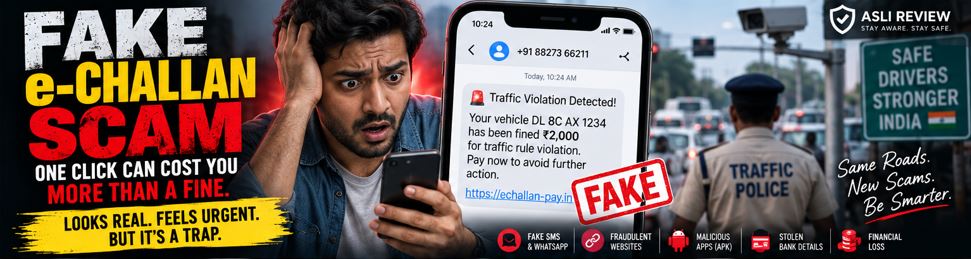
Fake e-Challan Scam in India 2026: Don't Pay This Traffic Fine
By AsliReview Team · 18 September 2026
Imagine this. You're sitting at home. Your phone buzzes. "Traffic Violation Detected. Challan Amount: ₹2,000. Pay immediately to avoid further action."
There is a vehicle number. There is a challan number. There is even a payment button. It looks official.
You think "maybe I really did jump that red light." You click. A website opens. It looks exactly like a government website. You enter your details, then your card or UPI information. You make the payment. Done. Or so you think.
A few minutes later, you notice something strange. The payment went somewhere else. Or your bank account suddenly shows an unauthorised transaction. Or the website asks you to install an application. And now the problem is much bigger than a traffic fine.
Welcome to the fake e-challan scam.
What Is the Fake e-Challan Scam?
An e-challan is a digital traffic enforcement record used by government transport and traffic authorities. The problem is that scammers are exploiting people's familiarity with genuine e-challan systems.
The Ministry of Home Affairs has repeatedly warned that cyber fraudsters are sending fake e-challans as part of attempts to empty victims' bank accounts — this campaign has recurred across multiple advisories through 2026. The government has also noted that India's cyber-fraud reporting system had saved more than ₹11,158 crore across more than 32.80 lakh complaints by 30 June 2026.
The scam usually follows a simple formula: fear → urgency → click → fake website → payment → loss. And the most dangerous part? The first message may look completely believable.
🚨 Fraud Snapshot
How the Scam Works

Step 1: You Receive a Scary Message
You may receive a message claiming "your vehicle has been fined for a traffic violation," containing a vehicle number, challan number, fine amount, date, alleged violation, payment deadline, and a link. The message is designed to make you think "I need to deal with this right now."
Step 2: The Scammer Creates Urgency
The message may suggest that your fine will increase, your vehicle documents could be affected, legal action may follow, or your challan is about to expire. This is psychological pressure — the scammer doesn't want you to investigate, they want you to click before thinking.
Step 3: You Click the Link
Instead of taking you to the genuine e-challan service, the link may lead to a fraudulent website designed to look official — complete with government logos, traffic police branding, familiar colours, challan terminology, vehicle-number fields, payment options, and fake customer-support numbers. Everything is designed to answer "does this look official?" The scammer hopes you never ask "did I reach the official website?"
Step 4: The Fake Website Asks for Information
The website may request your vehicle number, driving licence details, mobile number, name, date of birth, UPI information, card details, banking information, and OTP. The more information you provide, the more valuable the victim becomes.
Step 5: The Scammer Asks for Payment
Now comes the final part — you may be asked to pay ₹500, ₹1,000, ₹2,000, or another amount. It feels like a normal government payment, but your money may actually be going to the fraudster. And sometimes payment isn't even the biggest danger.
The Malware Version Is Even Worse
Some fake traffic-fine scams attempt to push victims toward malicious applications or files — "download the e-challan app to view your notice." That's a huge red flag. A traffic fine should not require you to randomly install an application sent through an SMS or WhatsApp link. Don't turn a ₹500 fine into a full-device compromise.
Why People Fall for It
Because the scam uses something incredibly powerful: a believable reason to click. Most people don't think "today I am going to fall for a cyber scam" — they think "I don't remember breaking a traffic rule, but maybe my car was caught on camera." That's enough. The scammer has successfully created doubt, then urgency, then the link.
The Psychology Behind the Scam
The fake e-challan scam usually combines three psychological triggers: fear ("you have violated traffic rules"), authority ("traffic police / government / e-challan"), and urgency ("pay immediately"). Together: fear + authority + urgency = click. That's why the message doesn't need to be technically sophisticated — it only needs to arrive at the right moment.
🚨 The Biggest Mistake: Checking the Fine Through the Message
This is where we need to change our behaviour. If you receive a challan message, don't use the link inside the message to verify the fine. Instead, open the official e-challan service yourself.
The official eChallan system, maintained by NIC for the Ministry of Road Transport & Highways, provides a facility to check challan status using identifiers such as challan number, vehicle number or driving-licence number. The genuine site is `echallan.parivahan.gov.in` — the official portal itself currently warns users about fraudulent websites and apps impersonating eChallan services, and security researchers have identified dozens of fake domains designed to look similar, such as ones ending in `.cyou` or `.eu.cc` rather than the official `.gov.in`.
Message says "₹2,000 fine"? Don't click. Open the official service yourself. Check. If the challan is genuine, it should appear through the authorised system.
The Golden Verification Rule
Never verify a government message using the link inside the message. Instead: message → don't click → open official website/app yourself → check challan → pay only if genuine. This tiny habit can eliminate a huge part of the risk.
🚩 Red Flags to Watch For
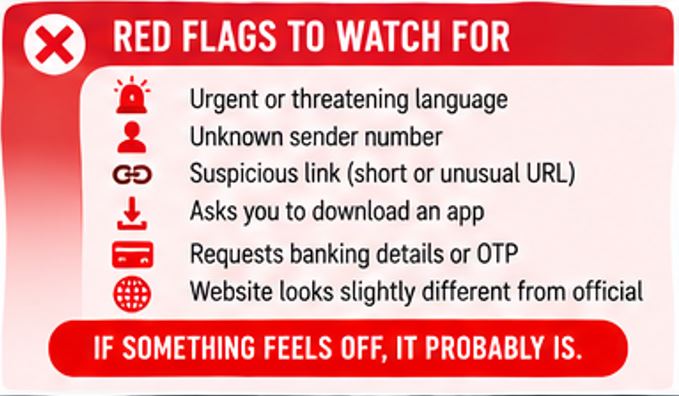
Be suspicious when a challan message:
- Creates extreme urgency
- Uses threatening language
- Comes from an unknown number
- Contains a strange-looking link
- Uses a shortened URL
- Asks you to download an APK
- Requests banking details
- Requests an OTP unexpectedly
- Asks you to install an "e-challan app"
- Contains spelling or grammar mistakes
- Redirects through several websites
- Uses a domain that isn't the official service
- Says your vehicle will immediately be seized unless you pay
Remember: a professional-looking message can still be fraudulent.
The "APK Trap"
This deserves special attention. Suppose your message says "traffic violation detected, download the e-Challan app to pay your fine." You click, and an Android application begins downloading with an .apk extension. Stop. Do not install it.
Government branding can be copied. Logos can be copied. Websites can be copied. But installing an unknown application gives the attacker something much more valuable: access to your phone, potentially exposing your SMS, notifications, contacts, files, banking information, authentication messages, and other sensitive data.
"But the Website Looks Exactly Like the Government Website!"
That's the point. A scam website doesn't need to look suspicious — it needs to look trustworthy enough for 30 seconds. Scammers can copy logos, fonts, colours, layouts, government terminology, payment screens, and helpdesk information. So don't judge a website by appearance — judge it by how you reached it.
The AsliReview 5-Second Challan Test
Received a traffic-fine message? Ask yourself:
- Did I open this message because I expected a challan? If not, stop.
- Did I click a link to verify it? If yes, stop.
- Did I independently open the official e-challan service? If no, verify first.
What to Do Instead
1. Don't Click the Message Link
Even if the message looks genuine.
2. Open the Official e-Challan Service Yourself
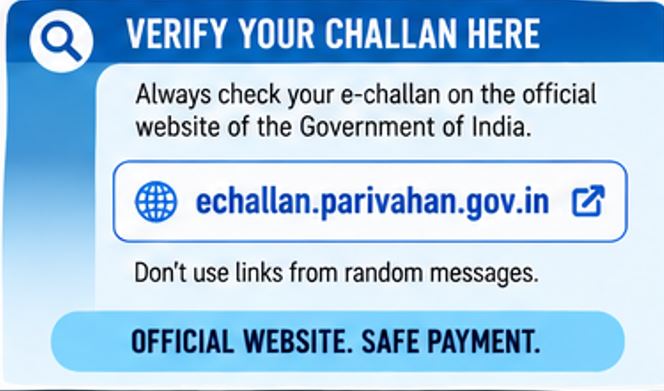
The official government eChallan portal (echallan.parivahan.gov.in) specifically warns users about fraudulent websites and mobile apps impersonating its services.
3. Check the Challan Independently
Use the vehicle number, challan number or other supported details on the official system, which provides challan-status checking facilities.
4. Never Install an APK From an SMS
Especially one claiming to be e-Challan, Traffic Police, RTO, Parivahan, Court, or another government service.
5. Never Share an OTP Just Because Someone Says It's for Challan Verification
An OTP is an authentication credential — treat it accordingly.
What If You Already Paid?
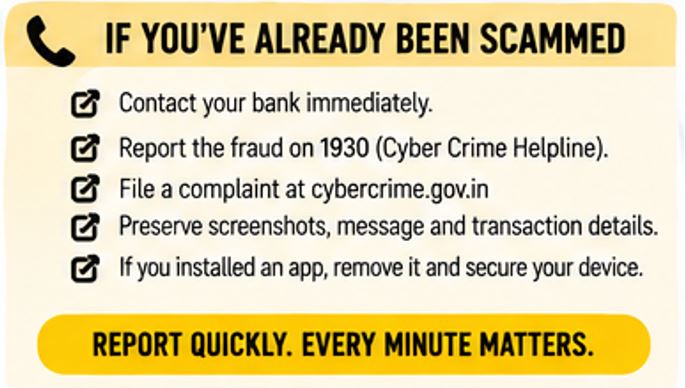
Don't wait. Immediately:
- Contact your bank/payment provider
- Check recent transactions
- Block or secure the affected payment instrument if necessary
- Report the financial fraud through 1930
- File a complaint on the National Cyber Crime Reporting Portal
- Preserve the original SMS/WhatsApp message
- Take screenshots of the fraudulent website
- Save the transaction ID
- Record the phone number and website used
- Don't delete evidence before documenting it
India's CFCFRMS system is specifically designed to enable rapid reporting of financial cyber fraud and help stop fraudulent funds from being siphoned away. Don't think "I'll report it tomorrow" — cyber fraud is a race against time.
What If You Installed the Fake App?
That's more serious. Don't simply uninstall it and forget about it. If you installed a suspicious app:
- Disconnect from the internet if appropriate
- Don't use the affected device for banking until it has been assessed
- Inform your bank if financial information may have been exposed
- Check your bank and UPI transactions
- Remove suspicious apps only after preserving relevant evidence
- Review sensitive permissions
- Change important passwords from a trusted device
- Consider professional device/security assistance if compromise is suspected
- Report financial fraud immediately if money has moved
📌 Reality Check
Myth: If I don't remember committing a traffic violation, the message must be fake.
Reality: Not necessarily — you may genuinely have a challan you don't remember. The correct response isn't "ignore every challan," it's "verify every challan independently." A genuine challan deserves to be paid; a fake challan deserves to be reported. The difference is verification.
📌 Reality Check
Myth: Government websites can't be copied.
Reality: They can. A fake website can imitate the appearance of an official service — that's why the official eChallan system itself warns users about fraudulent websites and apps impersonating it.
📌 Reality Check
Myth: The message contains my vehicle number, so it must be genuine.
Reality: No. Having some correct information doesn't automatically authenticate the message. Personal and vehicle information can circulate through many sources — data accuracy is not proof of sender authenticity.
The 10-Second Rule for Drivers
Whenever you receive an unexpected challan: don't click. Take 10 seconds. Open your browser yourself. Go to the official government service. Check the challan. If it's real, pay safely. If it's not, delete/report the message. That 10-second pause could save you thousands.
What Makes This Scam So Effective?
Because traffic fines are believable — that's the genius of the bait. If someone sends "Congratulations! You won ₹10 lakh," you may become suspicious. But "your vehicle has been fined ₹1,000" is completely believable. You own a vehicle. You drive regularly. Traffic cameras exist. Digital challans exist. Government messages exist. The scammer is exploiting a real system people already know.
The AsliReview "Don't Pay From the Message" Rule
Never pay a government fine directly from a random SMS or WhatsApp link. Instead: receive → pause → open official service → verify → pay. That's the safe sequence.
A Quick Example
Imagine you receive: "🚨 Traffic Violation Notice. Vehicle: DL XX XX 1234. Fine: ₹2,000. Pay within 24 hours to avoid further action. [PAY NOW]"
Don't: click "PAY NOW," download an app, call the number in the message, provide card details, or provide an OTP.
Do: open the official e-challan service yourself, enter your vehicle/challan details, check whether the challan exists, and pay only through the authorised system.
How Families Can Protect Each Other
This scam isn't limited to tech experts or older people — anyone can fall for a convincing traffic message. Share one simple rule with your family: if a traffic challan message arrives, don't tap the link — open the official website yourself. Especially tell parents, senior citizens, new drivers, family members who aren't comfortable with technology, and people who frequently use UPI. A 10-second conversation today could prevent a financial loss tomorrow.
How Businesses Can Protect Their Drivers
Companies should educate employees who use company vehicles with a simple policy: no challan payment through message links. Employees should verify the challan independently, use the authorised government service, inform the company if a suspicious message is received, and never install an APK received through SMS/WhatsApp.
What Should You Do With the Suspicious Message?
Don't forward it to friends "just to warn them" without context. Instead, screenshot it, record the sender number, save the URL, report it through appropriate cybercrime channels, and warn others without encouraging them to click the link. If money has already been lost, report it immediately through 1930 and the National Cyber Crime Reporting Portal.
The AsliReview 5-Second Rule: Traffic Fine? Don't Click. Verify.
SMS is not proof. WhatsApp is not proof. A logo is not proof. A vehicle number is not proof. A scary deadline is definitely not proof. The official system is where you verify.
Common Mistakes
- Clicking because the message looks official — appearance can be copied
- Paying because the fine amount is small — scammers often start with small amounts
- Installing an APK — this can create a much bigger security problem
- Calling the number in the message — you may simply connect yourself to the scammer
- Sharing OTP — never share an OTP with an unsolicited caller or message
- Ignoring suspicious activity after payment — report immediately
- Waiting until the next day — time matters in financial fraud
The Ultimate Checklist
Before paying an e-challan:
- Did I independently open the official e-challan service?
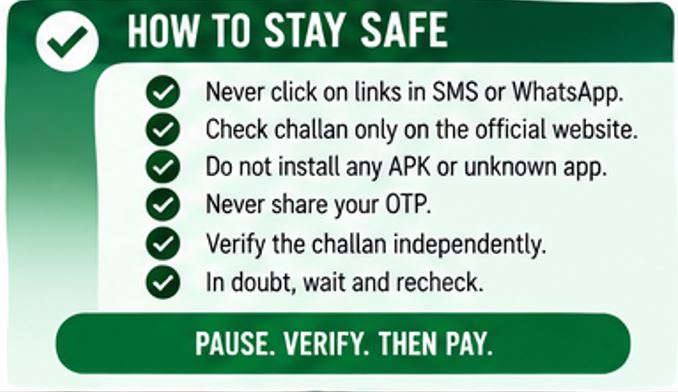
- Does the challan actually exist?
- Does the vehicle number match?
- Does the violation/date make sense?
- Am I using an authorised payment page?
- Did I avoid the link in the SMS/WhatsApp?
- Did I avoid installing an APK?
- Did I avoid sharing an OTP?
- Did I save the transaction/reference number?
If everything checks out, pay. If something doesn't, stop.
💡 AsliReview Tip
Don't verify the message. Verify the fine. A scammer wants you to ask "does this message look real?" You should ask "does this challan actually exist in the official system?" That's a much stronger question.
Final Takeaway
The fake e-challan scam works because it doesn't sound crazy — it sounds normal. You own a car. Traffic rules exist. Traffic cameras exist. e-Challans exist. And therefore the message feels believable. That's exactly why you need a process.
Don't panic. Don't click. Don't pay from the message. Open the official service yourself. Check the challan. Then decide.
Because the next time your phone says "₹2,000 traffic fine, pay immediately," your first reaction shouldn't be "oh no!" It should be "I'll verify that myself." And that tiny change in behaviour can make a very big difference.

Report it on AsliReview and help protect others from the same fraud.
🚨 Report a Fraud →