Part 11: Counterfeit Product Scams in India (2026): How to Spot Fake Products
By AsliReview Team · 31 August 2026
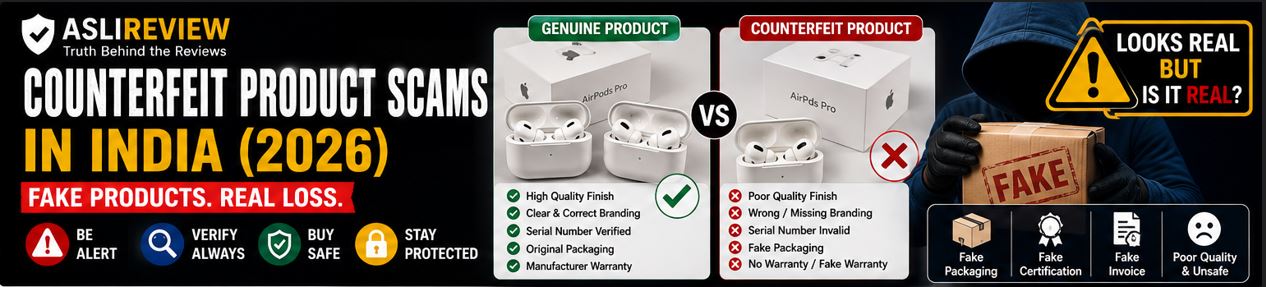
You order a branded product online. The website looks legitimate. The seller has good ratings. The package arrives. The box looks almost perfect. The logo is there. The product looks right.
You might even find a warranty card, a serial number, a barcode, a "Made in India" label, an invoice, an ISI mark, and a "100% Original" sticker. So you assume everything is genuine.
Then something feels wrong. The build quality isn't what you expected. The serial number doesn't work. The manufacturer doesn't recognize the product. The warranty turns out to be invalid. Or you compare it with a genuine product and discover they're not the same.
Welcome to one of the most difficult forms of consumer fraud: counterfeit product scams.
Counterfeit products aren't simply "cheap copies." Depending on the product, they can involve fake branding, fake certification marks, misleading packaging, fake serial numbers, fake invoices, duplicate accessories, substandard materials, false warranty claims, and products that don't meet the safety or quality characteristics advertised.
The National Consumer Helpline warns that heavily discounted products, poor grammar, low-quality images and websites that imitate brand-owner layouts can be warning signs of counterfeit products.
And the problem isn't limited to online shopping. Counterfeit products can appear through online marketplaces, social media, local shops, WhatsApp sellers, street markets, unofficial distributors, classified advertisements, and small e-commerce websites.
Financial loss, warranty loss and potentially safety risks
Best Protection
Verify seller, product, certification and invoice before buying
What Is a Counterfeit Product?
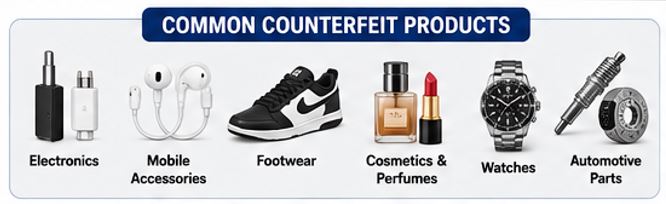
AsliReview_CounterfeitProductScam_CommonProducts
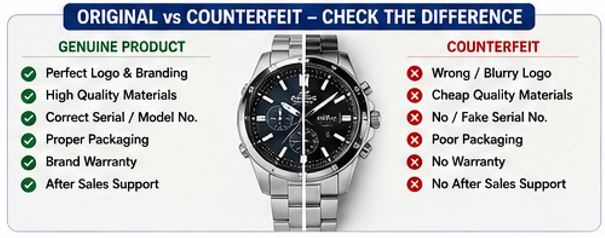
A counterfeit product is a product that is made or presented to deceive consumers into believing that it is genuine or authorized when it is not. You think you're buying Brand X Original Headphones but actually receive a fake product using Brand X's name, logo or packaging. The product may look similar, and may even work, but it isn't the genuine product you paid for.
Counterfeit vs Duplicate vs First Copy
You'll often see sellers using terms such as first copy, master copy, duplicate, replica, imported copy, export quality, OEM quality, original-like, or factory reject. These terms can be confusing. The important question isn't what the seller calls it — it's what the seller advertised versus what you actually received.
If a seller advertises an original branded product but knowingly sends a counterfeit one, that is a very different situation from openly selling an unbranded replica.
Why Counterfeit Product Scams Work
Counterfeiters understand something very well: people recognize brands faster than they verify products. You see the Nike logo, Apple logo, Samsung logo, ISI mark, or a hallmark, and your brain immediately thinks "genuine." But a logo can be copied. Packaging can be copied. A certificate can be copied. Even an invoice can be fabricated. That's why verification matters.
How Does a Counterfeit Product Scam Work?
Step 1: The Seller Finds a Popular Product
Counterfeiters generally benefit from products people already want — smartphones, earphones, watches, shoes, cosmetics, perfumes, car parts, power adapters, electrical products, kitchen appliances, and jewellery.
Step 2: The Product Is Made to Look Genuine
The fake product may include a brand logo, similar packaging, similar colours, a fake serial number, a barcode, a warranty card, and a certification mark.
Step 3: The Seller Creates Trust
The listing may say "100% Original," "Genuine Product," "Official Warranty," "Imported Directly," or "Authorized Seller." But these claims need verification.
Step 4: The Product Is Sold Through a Trusted-Looking Channel
The counterfeit product may appear on a marketplace, a social-media page, a local website, a WhatsApp catalogue, a classified listing, or a physical shop.
Step 5: The Consumer Receives the Product
Initially, everything looks fine. Then the problems start.
What Happened? An Illustrative Example
Let's say Rahul wants to buy a branded digital multimeter. The genuine product normally costs around ₹6,000. He finds one online for ₹2,999. The seller says "100% original. Imported stock," and the listing contains brand photographs, five-star reviews, warranty information, and a GST invoice.
Rahul orders it. The package arrives and the box looks almost identical to the genuine product. But after using it, he notices strange readings. He contacts the manufacturer, who asks for the serial number — it isn't recognized. Rahul later discovers that the product is a duplicate.
The lesson? Packaging is not proof of authenticity.
The National Consumer Helpline has documented an actual e-commerce grievance involving a consumer who purchased a branded digital clamp multimeter but received a duplicate low-quality product instead. The consumer's complaint was eventually resolved through the platform's grievance process.
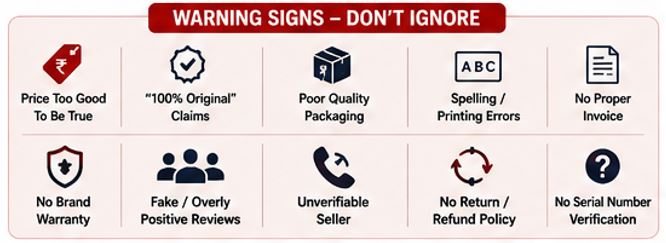
AsliReview_CounterfeitProductScam_WarningSigns
🚩 Warning Sign #1: The Price Is Far Below Normal
This is one of the strongest warning signs. Suppose a genuine product normally sells for ₹25,000 but one seller offers it for ₹7,999. There could be a legitimate reason — clearance sale, older model, refurbished item, open-box product, or a genuine promotion. But the seller should be able to explain the difference.
The National Consumer Helpline specifically advises consumers to compare prices and use caution when the price is significantly different from similar products. Compare the same model on the manufacturer's website, established retailers, major marketplaces, and authorized sellers — and compare the exact model number, not just the product name.
🚩 Warning Sign #2: "100% Original" Is Repeated Everywhere
A seller who keeps saying "100% ORIGINAL" isn't necessarily lying, but repeated claims aren't proof. The better question is: can I independently verify that it is genuine?
🚩 Warning Sign #3: The Seller Uses "First Copy"
This is a major warning sign if you're looking for an original product. "First copy" is not another word for genuine. If you want an original branded product, don't buy a copy expecting original quality.
🚩 Warning Sign #4: Packaging Looks Slightly Wrong
Look carefully. Compare the logo, font, printing quality, spelling, colour, box dimensions, labels, serial number, product model, and accessories. Counterfeiters can get very close, but small differences often appear.
🚩 Warning Sign #5: Spelling Errors
Look for things such as "Bluetoth" instead of "Bluetooth," or "Originale Product" instead of "Original Product." One spelling mistake doesn't prove a product is fake, but multiple strange errors should make you cautious.
🚩 Warning Sign #6: Serial Number Doesn't Match
A genuine product may have a serial number, IMEI, model number, batch number, QR code, or product registration number. Check whether the manufacturer provides a way to verify it — but remember, a serial number alone isn't proof, since counterfeiters can copy genuine serial numbers.
🚩 Warning Sign #7: Warranty Is "Seller Warranty"
You purchase a product expecting brand warranty but discover it's actually "seller warranty" instead — these are not necessarily the same. Before buying, ask who provides the warranty — manufacturer, authorized distributor, or seller — and get the answer in writing.
🚩 Warning Sign #8: No Proper Invoice
A seller may say "Don't worry, I'll send the bill later." Be careful — a proper invoice can be important evidence in a dispute. The National Consumer Helpline advises consumers to keep transaction records and documentation.
🚩 Warning Sign #9: The Invoice Looks Suspicious
A fake product can sometimes come with a fake-looking invoice. Check the seller name, address, GST details where applicable, invoice number, date, product description, model number, amount, and tax details. Don't assume "it has an invoice, so it's genuine."
🚩 Warning Sign #10: The Seller Refuses Product Verification
For expensive products, you may ask "Can I verify the serial number before buying?" If the seller becomes unusually defensive, that's worth noticing.
🚩 Warning Sign #11: The Seller Says "Brand Warranty Is Not Required"
Be cautious if the product is advertised as genuine but the seller avoids questions about warranty, manufacturer support, authorized dealership, or serial-number verification.
🚩 Warning Sign #12: Reviews Mention Different Products
This happens more often than people realize. The listing says "Original Bluetooth Earbuds" but reviews talk about a different colour, different model, different brand, or different packaging. That may indicate listing manipulation or product variation.
Watch for "Amazing product!" "Best quality!" "Original 100%!" "Must buy!" with almost no detailed information. Fake or low-quality reviews can create false confidence. India's Department of Consumer Affairs has recognized the importance of genuine online reviews and introduced a framework around fake and deceptive reviews in e-commerce.
🚩 Warning Sign #14: Product Quality Is Too Poor for the Claimed Brand
Sometimes you don't need a laboratory — the product itself gives clues. Cheap plastic, uneven printing, loose buttons, poor stitching, bad finishing, strange smell, incorrect accessories, poor sound quality, and unusual battery behaviour. One clue isn't enough. Multiple clues should trigger verification.
🚩 Warning Sign #15: The Seller Says "It's Exactly the Same"
You may hear "same factory," "same quality," "only logo is different," or "company sells for ₹20,000, but we sell for ₹5,000." Don't automatically believe these claims. If you're paying for an original branded product, verify that you're actually receiving one.
Counterfeit Products That Deserve Extra Attention
Some fake products are mostly a financial problem. Others can create serious safety concerns. Be especially careful with counterfeit electrical products, chargers, power adapters, batteries, helmets, automotive parts, cosmetics, medicines, children's products, safety equipment, kitchen appliances, and gas-related equipment.
A counterfeit charger isn't merely disappointing. A counterfeit safety product may fail when you actually need it.
Electrical Products: Don't Take the Risk
Fake electrical products can have poor insulation, substandard components, incorrect ratings, poor-quality wiring, and fake certification marks.
BIS actively enforces misuse of the ISI Standard Mark. It notes that unauthorized manufacturers can misuse or imitate the mark, and genuine ISI-marked products carry a BIS licence number that helps identify the licensed manufacturer.
💡 AsliReview Tip
For products where BIS certification applies, don't just look for an ISI logo. Look for the associated licence information and verify it using official BIS tools where available.
How to Verify an ISI Mark
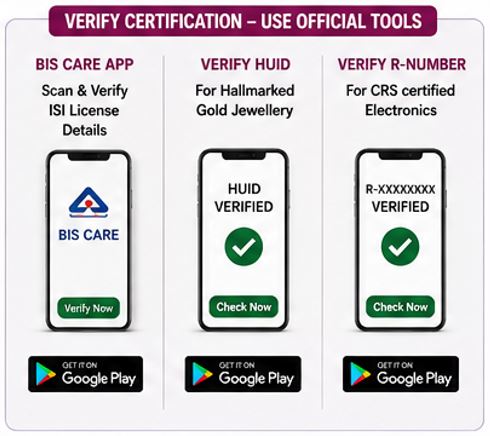
The BIS Care App allows consumers to verify licence details for products carrying the relevant BIS mark. BIS also provides complaint functionality for misuse of BIS standard marks. A genuine ISI mark is associated with a licence number — BIS explains that the licence number, represented as CM/L-..., helps identify the manufacturing unit associated with the certification.
Important: don't assume ISI logo equals genuine. Verify the associated licence details.
Fake ISI Mark Scam
This deserves its own section. A counterfeit product may display something resembling ISI, but the marking may be unauthorized or deliberately designed to look official. BIS specifically warns about misuse and imitation of the Standard Mark and conducts enforcement against unauthorized use.
If the product is supposed to carry BIS certification, look for the relevant mark, check the licence information, and verify it through official BIS resources. If something doesn't match, don't assume it's genuine.
Jewellery: Don't Trust the Hallmark Alone
Gold jewellery is another area where authenticity matters enormously. A jewellery piece may carry markings that look convincing. For hallmarked gold jewellery, BIS provides the Verify HUID feature through the BIS Care App — BIS states that consumers can use the HUID feature to verify the authenticity of hallmarked gold jewellery before purchase.
AsliReview Tip
For hallmarked jewellery, don't just look at the hallmark — check the HUID through the official BIS system.
Electronics: Serial Number Isn't Enough
A fake electronic product may contain a serial number copied from a genuine product. So use multiple checks: model number, serial number, manufacturer verification, packaging, accessories, warranty, seller identity, and product registration.
For certain electronics covered by BIS's Compulsory Registration Scheme, the BIS Care App also provides an R-Number verification feature.
Cosmetics and Beauty Products
Counterfeit cosmetics can be especially concerning because they are applied directly to the body. Watch for a strange smell, different texture, poor printing, missing batch details, incorrect spelling, unclear manufacturer information, extremely low price, and packaging differences. Don't assume a famous logo means the contents are genuine.
Automotive Parts
Fake automotive parts can be much more than a financial problem. Counterfeit brake components, filters, belts, lamps, bearings, and safety parts may not perform like genuine products. For critical vehicle components, buy through trusted/authorized channels and verify the part number and manufacturer.
Fake "Original" Phone Accessories
This is extremely common. You may see "original charger — ₹399" when the genuine accessory normally costs much more. The product may physically work, but that doesn't mean it meets the same specifications. With chargers and adapters, don't judge authenticity only by whether your phone charges.
How to Check a Product Before Buying
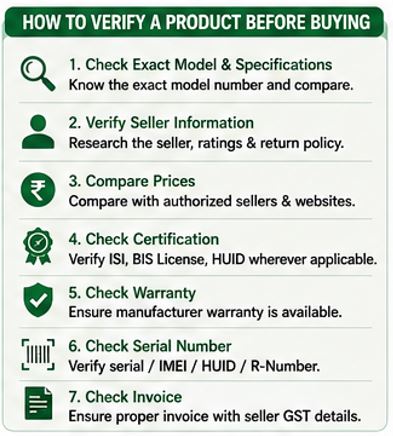
Step 1: Identify the Exact Model
Don't search only "Samsung charger" — find the exact model number, part number, and variant.
Step 2: Check the Manufacturer's Website
Look for product photographs, packaging, specifications, model number, warranty, and authorized sellers.
Step 3: Compare the Price
A major price difference deserves investigation.
Step 4: Verify the Seller
Ask who is selling it, whether they're authorized, how long they've been selling, and whether independent reviews exist.
Step 5: Check Certification
If the product is supposed to carry a BIS mark or other applicable certification, verify it.
Step 6: Check the Packaging
Look at the printing, spelling, labels, model number, serial number, and manufacturer information.
Step 7: Check the Invoice
Make sure the product description and model match what you purchased.
What Happened? The "Genuine Box, Fake Product" Scam
Imagine buying a branded appliance. The box is genuine-looking. You open it. The product has the same logo. But the internal components are different. This is why packaging alone should never be treated as final proof — a counterfeit product can be packaged extremely well.
The AsliReview 7-Point Authenticity Test
Before buying an expensive branded product:
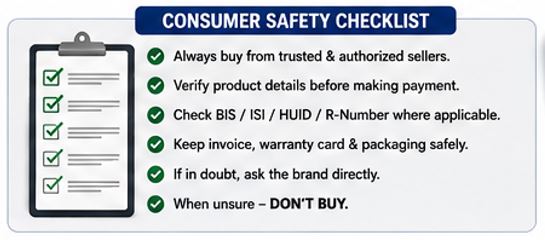
AsliReview_CounterfeitProductScam_SafetyChecklist
Seller — who is selling it?
Price — does the price make sense?
Model — is the exact model number correct?
Packaging — does it match the manufacturer's official information?
Certification — can applicable certification be independently verified?
Warranty — does the manufacturer recognize the warranty?
Invoice — does the invoice accurately identify the seller and product?
If several answers are unclear, don't buy yet.
❌ Common Mistakes
Assuming a logo means genuine — logos can be copied
Trusting the packaging — packaging can be copied too
Trusting the invoice — invoices can be incorrect or fraudulent
Believing "imported" means original — it doesn't
Believing "factory reject" means genuine — it doesn't automatically mean anything
Buying because "everyone is buying it" — popularity isn't proof of authenticity
Ignoring a huge price difference — a large discount should trigger research
Not checking the exact model — a genuine-looking product may still be a different or older variant
📌 Reality Check
Myth: If the product has the original logo, it's genuine.
Reality: A counterfeit manufacturer can copy a logo. Verify the product through the manufacturer, seller and applicable certification systems.
📌 Reality Check
Myth: ISI printed on the product means BIS approved.
Reality: BIS specifically warns about misuse and imitation of the ISI Standard Mark. For applicable products, verify the associated licence details through official BIS resources.
📌 Reality Check
Myth: A fake product will always look cheap.
Reality: Modern counterfeit products can look remarkably convincing. Packaging quality alone isn't enough.
📌 Reality Check
Myth: If it works, it's genuine.
Reality: A counterfeit product can work. The question is whether it is actually the product you were promised and whether it meets the relevant quality, safety and certification requirements.
📌 Reality Check
Myth: A GST invoice proves the product is original.
Reality: An invoice can provide useful transaction evidence, but it does not by itself establish product authenticity.
What If You Receive a Counterfeit Product?
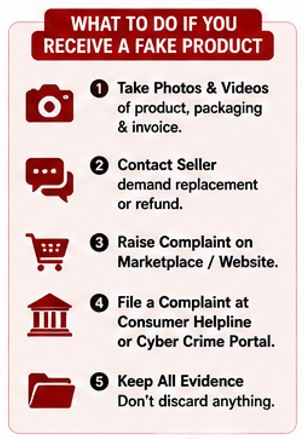
Don't immediately throw it away. Keep everything.
Step 1: Photograph the Product
Take clear photographs of the product, packaging, labels, serial number, model number, certification marks, and barcode.
If you compare it with the manufacturer's official product, document what differs.
Step 3: Contact the Manufacturer
Ask the manufacturer whether the serial number is valid, the model exists, the product is genuine, the warranty is valid, and the seller is authorized. If possible, keep their response.
Step 4: Contact the Seller
Use written communication, not just a phone call. Ask for a replacement, refund, explanation, or authenticity proof.
Step 5: Contact the Marketplace
If purchased through an online marketplace, open a formal complaint and attach your evidence.
What If the Seller Says "No Refund"?
Don't automatically assume the matter is over. If the product is defective, spurious, counterfeit or materially different from what was advertised, consumer-protection rules can provide relevant rights and remedies depending on the circumstances. India's Consumer Protection (E-Commerce) Rules, 2020 include provisions dealing with defective, deficient, spurious or misrepresented goods and refunds in relevant circumstances.
The Department of Consumer Affairs also states that the Consumer Protection Act, 2019 provides consumer commissions and remedies for unfair trade practices, including matters involving spurious goods.
What If the Marketplace Says "Contact the Seller"?
Do it, but keep your complaint documented. If the issue isn't resolved, you can consider escalating through the appropriate consumer-grievance mechanism. The National Consumer Helpline provides channels for consumer grievances and has documented e-commerce cases involving duplicate and counterfeit products.
National Consumer Helpline
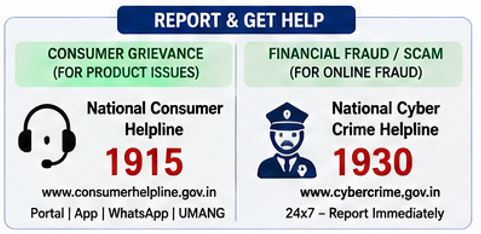
For consumer grievances such as a fake product, wrong product, defective product, non-delivery, refund dispute, or service deficiency, the National Consumer Helpline can be an appropriate escalation route. The current NCH system provides multiple grievance channels, including its portal, app, UMANG and WhatsApp.
Remember: consumer grievance → National Consumer Helpline. Financial cyber fraud → 1930 / National Cyber Crime Reporting Portal. These routes can overlap depending on what happened.
What If You Lost Money Through an Online Counterfeit Scam?
If you believe the transaction involved deliberate online financial fraud:
AsliReview_CounterfeitProductScam_Report
Step 1: Contact Your Bank
Inform the bank/payment provider immediately.
Step 2: Call 1930
The National Cyber Crime Reporting Portal currently states that financial cyber fraud should be reported immediately through 1930, which operates 24×7.
Keep payment details, UPI ID, website, seller phone number, listing, screenshots, invoice, chats, product photographs, and the manufacturer's response.
What If the Product Carries a Fake BIS/ISI Mark?
This is worth reporting separately. BIS provides consumer mechanisms for reporting misuse of its Standard Mark and has enforcement processes against unauthorized use. The BIS Care App also provides a complaints facility for quality issues and misuse of BIS standard marks.
Buy from the right source — for expensive branded products, prefer the manufacturer, authorized dealer, established retailer, or reputable marketplace seller.
Check the exact product — don't compare "iPhone charger," compare the exact model/part number.
Check the price — a large unexplained discount deserves investigation.
Check the seller — don't trust a seller solely because the marketplace is famous.
Check the warranty — ask who provides it.
Check the certification — where applicable, verify BIS licence, ISI mark, HUID, R-number, or other relevant certification using official verification tools where available.
💡 AsliReview Tip — Don't Ask "Does It Look Original?"
AsliReview_CounterfeitProductScam_HowToVerify
Ask "Can I verify that it is original?" That's a much better question. A counterfeit product's entire purpose is to look genuine, so appearance alone is exactly what the scammer wants you to trust.
The AsliReview Authenticity Checklist
Before buying an expensive branded product:
Exact model number verified
Seller independently researched
Price compared with genuine sellers
Product photographs checked
Manufacturer information verified
Warranty provider confirmed
Applicable certification checked
Serial/registration details verified where possible
Return/refund policy understood
Proper invoice available
Payment made through a reasonably protected method
Evidence saved
If several boxes remain unchecked, wait before paying.
The "Original or Just Original-Looking?" Test
When you see a product advertised as "100% ORIGINAL," don't stop there. Ask: who is selling it? Why is it so cheap? Is the exact model genuine? Is the warranty recognized? Can the certification be verified? Does the manufacturer recognize the product? Is the invoice legitimate? What happens if it turns out to be fake?
If the seller can't answer basic questions, walk away.
Frequently Asked Questions
How can I identify a counterfeit product?
Look for inconsistencies in packaging, spelling, model numbers, seller information, price, warranty, serial numbers and product quality. For applicable products, verify certifications through official systems rather than relying on the printed mark alone.
Yes. A serial number by itself doesn't prove authenticity. Where possible, verify it through the manufacturer's official system.
Can fake products have fake invoices?
Yes. An invoice is useful evidence of the transaction, but it isn't proof that the product itself is genuine.
How can I check an ISI mark?
For applicable products, use official BIS verification tools. The BIS Care App provides a Verify Licence Details function, and BIS explains that genuine ISI-marked products carry associated licence information.
How can I verify hallmarked gold jewellery?
BIS provides a Verify HUID feature through the BIS Care App for hallmarked gold jewellery. BIS says consumers can use it to verify the authenticity of hallmarked jewellery before purchase.
Is a product with an ISI logo always genuine?
No. BIS specifically warns about misuse and imitation of the Standard Mark. Verify the associated licence information through official BIS resources.
Is a very cheap branded product automatically fake?
No. It could be a genuine sale, older model, clearance item or other legitimate offer. But a major unexplained price difference should trigger additional verification.
Keep the product, packaging, invoice and communication. Photograph everything. Contact the seller and marketplace in writing. If the issue isn't resolved, consider the National Consumer Helpline or other appropriate consumer remedies.
What if the seller refuses a refund?
Document the refusal. If the product is counterfeit, spurious, defective or materially different from what was advertised, consumer-protection rules may provide relevant remedies depending on the circumstances.
Should I throw away a counterfeit product?
Not immediately. Keep the product and packaging until the dispute or complaint is resolved — they may be useful as evidence.
Can I report a fake ISI mark?
Yes. BIS provides complaint mechanisms for misuse of its Standard Mark, including through the BIS Care App.
What if I paid a fake seller through UPI?
Contact your bank/payment provider immediately. If you believe it was financial cyber fraud, call 1930 and report it through the National Cyber Crime Reporting Portal.
What if the product is fake but I didn't lose money?
You can still report the issue to the seller, marketplace, manufacturer and relevant consumer/certification authority. Reporting suspicious products can help prevent other consumers from being affected.
Related AsliReview Guides
This article connects closely with AsliReview's guides on fake shopping websites, online marketplace scams, fake customer care scams (warranty and refund claims), fake refund scams, and UPI fraud — together forming a growing consumer-protection cluster.
Final Word
A counterfeit product scam is different from a normal bad shopping experience. A product can be cheap and still genuine. It can be expensive and still fake. It can have beautiful packaging and still be counterfeit. It can even come with an invoice, warranty card and serial number.
That's why the most important lesson isn't "look carefully at the product." It's "verify the product."
Before buying an expensive branded product: check the seller, check the exact model, compare the price, check the warranty, verify applicable certifications, check the invoice, and keep your transaction records. And for products covered by BIS certification, don't stop at the ISI logo — BIS provides tools such as BIS Care to verify licence details and, where applicable, HUID or R-number information.
If you receive a counterfeit product, don't throw away the evidence. Keep the product, the packaging, the invoice, the seller's messages, the payment record, and the manufacturer's response.
If it was an online financial fraud, act quickly and call 1930. If it is a consumer dispute involving a fake, defective or wrong product, use the appropriate consumer-grievance route.
And most importantly: don't let the word "ORIGINAL" convince you. Anyone can print the word. Verification is what matters.
AsliReview_CounterfeitProductScam_Footer
Been cheated by a vendor?
Report it on AsliReview and help protect others from the same fraud.