By AsliReview Team · 9 October 2026
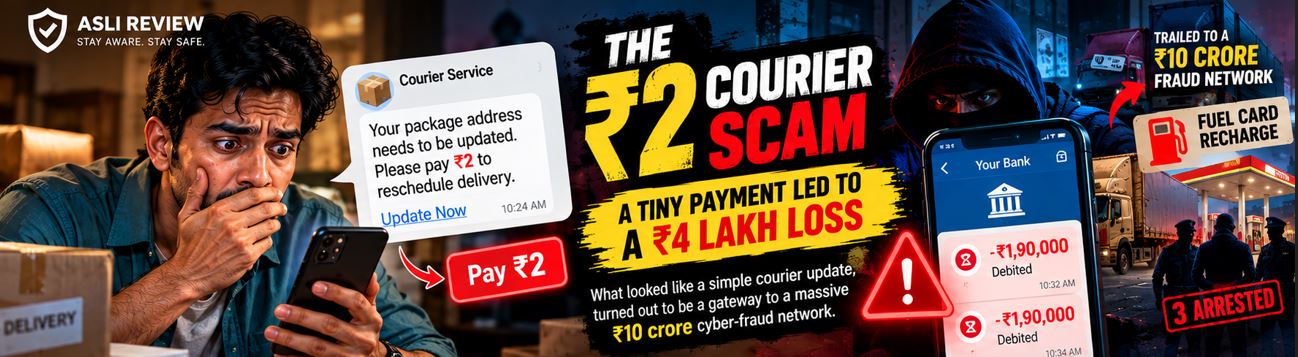
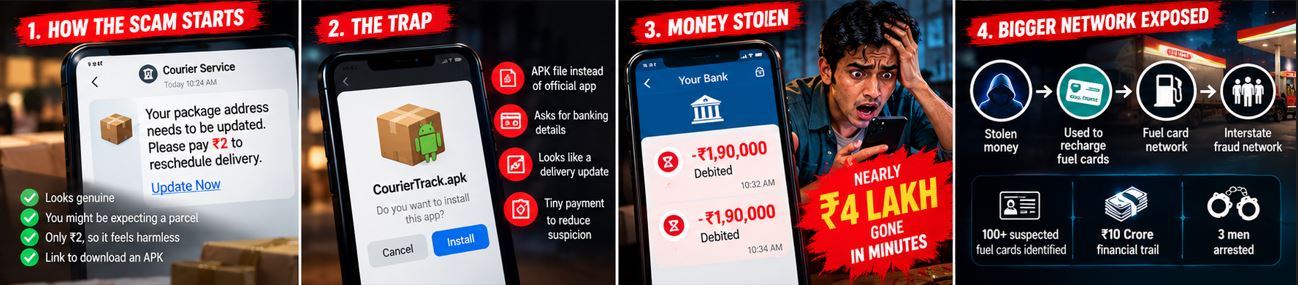
You get a message: "Your courier address needs to be updated." Nothing unusual — you're expecting a parcel. It asks you to install an APK and pay ₹2 to update the delivery address. Just ₹2. What could possibly go wrong?
According to Delhi Police, a Southeast Delhi resident did exactly that on May 7 — installed the app, entered his banking details, and paid. Within minutes, two withdrawals of ₹1.9 lakh each drained nearly ₹4 lakh from his account.
That alone would be a familiar APK-scam story. But when investigators followed the stolen money, they reportedly found around ₹3.9 lakh had been used to recharge a prepaid smart fuel-card account — a trail that led to a suspected interstate network involving more than 100 fraudulent fuel cards and a financial trail of roughly ₹10 crore. Three men were arrested; the investigation was ongoing.
AsliReview Editorial Note: This case is reported by Delhi Police and covered in the press (The Times of India, The420.in). The core incident — ₹2 payment, APK install, ~₹4 lakh loss — is well corroborated. Details of the wider network (the ₹10 crore figure, the number of fraudulent cards, allegations against unnamed others) remain under investigation, and we present them as reported rather than independently confirmed.
### Fraud Snapshot
### How It Works
1. A plausible, low-stakes trigger — "your address needs updating," "your parcel couldn't be delivered" — arrives by message, playing on the fact that almost everyone is waiting on some delivery. 2. A near-zero payment request (₹2) makes the ask feel administrative rather than financial — nobody pauses to scrutinize ₹2 the way they would ₹2,000. 3. The "update" requires installing an APK instead of using the courier's official app or website — the point where device access, not money, becomes the real target. 4. Banking credentials are entered while completing the tiny payment — the APK or linked page captures far more than ₹2 worth of access. 5. Large withdrawals follow within minutes, often before the victim realizes anything is wrong. 6. The stolen money moves through additional layers (in this case, a fuel-card recharge) before reaching its final destination — making it harder to trace and recover.
### Why It Works
### Warning Signs
### Reality Check
### What To Do
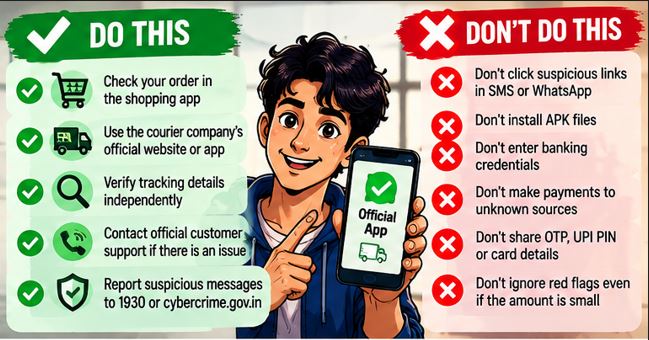
1. Never install an APK sent through an unsolicited courier message. Use the courier's official app (from the Play Store/App Store) or website to track or resolve delivery issues. 2. Verify independently — check the order directly in the shopping app/website where you placed it, and find the courier info there rather than trusting the message. 3. Treat any request for banking credentials tied to a "delivery fee" as a hard stop, regardless of how small the amount is. 4. If you've already lost money, contact your bank immediately and call 1930 (National Cyber Crime Helpline) or file at cybercrime.gov.in without delay. 5. Preserve evidence before deleting anything — the message, sender number, APK file name, screenshots, and transaction IDs/UTRs.
### Frequently Asked Questions
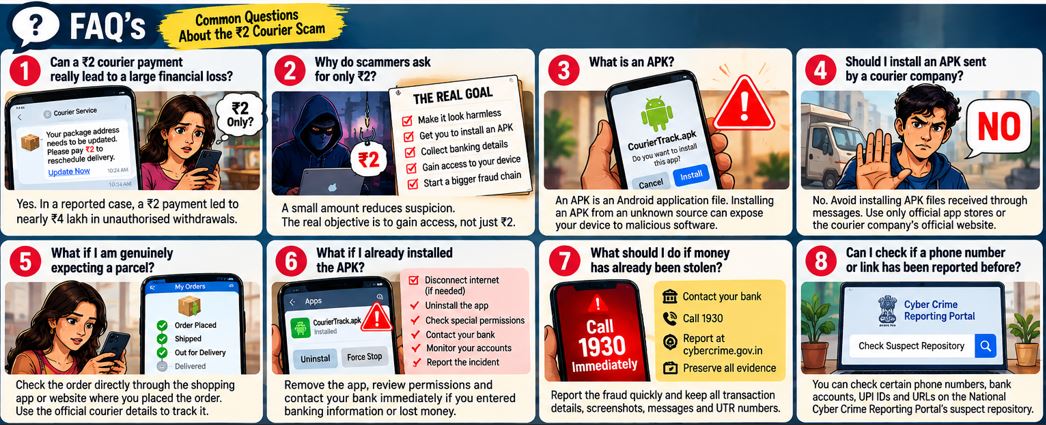
Can a ₹2 payment really lead to a ₹4 lakh loss? In this reported case, yes — the ₹2 payment wasn't the risk itself; installing the APK and entering banking credentials alongside it was. The small amount was bait to lower suspicion, not the actual transaction that caused the loss.
Why would scammers ask for such a tiny amount? A near-zero amount reduces suspicion and gets the victim to install the app or enter credentials — the actual theft happens through that access, not the ₹2 transaction itself.
Should I ever install an APK sent by a "courier company"? No. Get courier apps only from official app stores or the courier's own website. An APK file arriving through an unsolicited message is a red flag regardless of how convincing the message looks.
Where do I report this kind of fraud? Call 1930 or file at cybercrime.gov.in as soon as possible, and contact your bank immediately to flag any unauthorized transactions.
---
*Sources: The420.in — ₹2 Courier Scam Uncovers Suspected ₹10 Crore Fraud Network, additional coverage via The Times of India. Details of the wider suspected network remain under investigation and are presented as reported.*
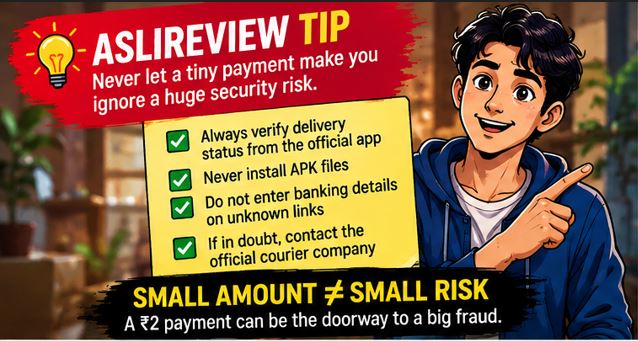
AsliReview Tip: Judge a payment request by the access it asks for, not the amount on the screen. A ₹2 charge that wants an APK install and your banking password is asking for far more than ₹2.
Report it on AsliReview and help protect others from the same fraud.
🚨 Report a Fraud →